The architectures

One hundred and four system shapes. Every one of them runs.

Not tips, not principles, not a list of things I believe about agents. These are structures — what the parts are, which one is allowed to write, who is allowed to refuse, and where the loop closes. Each entry gives you the name, one sentence, the diagram, the participants, and the repository it runs in. If a shape is new to you, take it; that is what it is here for.

One hundred and four is what is standing today. Below them sits the other half of the catalog — 57 working disciplines these machines are built out of. Those are real and they are secondary: a discipline tells you how to hold a claim, an architecture tells you what to build.

Skip to the 57 disciplines ↓

Nine groups The substrate Worlds, and the things that live in them The selection machinery Systems that develop themselves How work is routed Operating systems for agents Inside one agent turn The compiler wing Stores that judge what enters them

  READING THE DIAGRAMS

    [ seat ]     a slot an agent or a model occupies. it PROPOSES.
    ( organ )    code. it executes, measures, refuses, or decides.
    { state }    the durable thing many read and exactly one writes.
    -->          a move, an arrow of causation, or a hand-off.

The substrate everything composes on

Before the worlds and before the compilers there is one type and one method. Four shapes at that layer: the algebra itself, the loop that judges, the unit that runs one model turn, and the adapter that lets absolutely anything be a step in it.

One Type, One Method — and a sequence is a step

A whole composition algebra out of a single abstract class with one method, where the class that runs a sequence of steps is itself a step. Failure comes back carrying the tree address of the leaf that failed, because every enclosing sequence prepends its own index on the way back up — a coordinate instead of a stack trace.

   ( STEP )   one method:  run(context) --> result
                            result = { status, context, error, resume }
              status is one of four: done | blocked | error | awaiting-input

   ( SEQUENCE )   IS-A ( STEP )        <-- the whole trick
        |
        |  the context is a plain dict, threaded through
        |  each step RETURNS a whole context; the sequence re-binds it
        |  the first non-done result aborts the rest
        v
   on the way back up, EVERY enclosing sequence PREPENDS its own index:

     [ a , [ b , [ c , d ] ] , e ]     d fails -->  resume = 1.1.1
                                       the ADDRESS of the leaf

   everything above is a subclass, so it all nests:
     the evaluator loop   a sequence plus a judge
     the compiler         a sequence whose PRODUCT is a step
     the parallel form    a sequence that runs its steps at once, each
                          on its own deep copy, merged at the join
     a whole agent turn   still a step
     an entire world      still a step
  • No shared mutable object. A step receives a context and returns one; the sequence re-binds. A step’s writes reach the next step only by being returned, which is what makes the parallel form a deep copy per branch rather than a race.
  • Four statuses, and “out of cycles” is not “broken.” A parent can tell an unfinished loop from a failed one without parsing an error string.
  • The same object renders itself as a readable tree, so the structure is inspectable by the model executing it — the composition is a surface, not an implementation detail.
  • This is the closure law at the smallest scale. A world is an agent for exactly the same reason a sequence is a step.

Runs in universal-chain-ontology

The Evaluator Loop

A sequence that, after running, runs one more step — the judge — then reads the verdict out of the shared context by key. Approved ends it. Not approved loops, with the judge’s critique still sitting in the very context the workers will read next cycle, because there is no separate verdict channel for it to be moved through.

   at most N cycles:

        ( THE SEQUENCE )   the work
              |  not done? return immediately
              v
        [ THE JUDGE ]   an ordinary STEP -- so a plain function, a live
              |         model seat, or an entire nested sequence can
              |         hold this seat
              v
        is the approval key set?
              yes --> DONE
              no  --> loop. the feedback is ALREADY in the context.

   fell out of the loop --> BLOCKED, carrying every cycle's context

   the approval key is the WHOLE trust boundary. the loop never
   inspects the work -- it reads one key. who is allowed to set that
   key is the entire design.
  • The critique reaches the retry because it was never moved. Same dict, same keys, next cycle.
  • Blocked is not an error, so a caller can distinguish “the loop ran out of patience” from “something broke” and still read everything that was produced.
  • A prose fallback for model judges: if no boolean was set, the judge’s own text is scanned for its approval word — so a judge that merely talks still closes the loop instead of hanging it.

Runs in universal-chain-ontology

The Agent Turn in Three Parts

One model turn split into three differently-typed pieces: a context-assembly sequence, a serializable configuration that is the message, and the generation moment that routes to a backend. And a question for a human is not a callback — it is a status: the assembly stops and hands back the prompt, the key to fill, and the index to resume at.

   [ ONE AGENT TURN ]   and the turn is itself a STEP, so it nests

   ( ASSEMBLE )   inject a file, an environment value, a function's
        |         result, a retrieval; weave a range out of an earlier
        |         session; dovetail a typed output into a named input
        |
        '--> hits a HUMAN element --> status: AWAITING-INPUT
                                       { the prompt, which key to fill,
                                         resume at index i+1 }
                                      the pause PROPAGATES up the whole
                                      chain. resumable state, not a
                                      blocking call.
        |
        v
   { THE CONFIG }   IS the message: model, provider, temperature, turn
        |            ceiling, permission mode, allowed tools, servers
        v
   ( GENERATE )   route to a backend; merge the output into the context

   assembly only touches context. generation only generates. the config
   is the wire between them -- which is exactly why the same object can
   ALSO compile itself into a graph runtime. two execution surfaces,
   one definition.
  • The gate is free. An awaiting-input or failed assembly returns before the model is called, so a human veto costs zero tokens.
  • Every injected value declares the key it writes, so the provenance of each context entry is a declaration rather than an archaeology problem later.
  • The human sits inside the chain as an element, and the resume coordinate rides in the result — so whoever holds the chain owns the wait, and nothing blocks a thread to have it.

Runs in sdna

The Any-Runnable Adapter

One function that makes anything a step. Already a step? Returned untouched. Otherwise it is probed for a run method, then a message handler, then a send method, then plain callability — awaited if it is async, pushed off the loop if it is not — and its reply is written into three context keys at once.

   as-a-step( object, name )
      |
      +-- already a STEP -----------------------------> returned unchanged
      |
      '-- otherwise, probe in order:
              a run method --> a message handler --> a send method
              --> is it just callable?
              async? await it.  sync? run it off the event loop.
                    |
                    v
        the reply is written THREE TIMES:

          under the key the author asked for
          under "output"          POSITIONAL: "the previous step's reply"
          under "output:<name>"   NAMED: addressable fan-in

        and the read side mirrors it:
          input = the named key, else "output", else "goal", else "input"

        which is why a bare sequence of three things works with no
        wiring at all.

   a foreign runtime that raises does NOT unwind past the algebra --
   it becomes an ERROR status the enclosing sequence gates on.
  • The three-key write is the calling convention: positional for pipelines, named for fan-in, explicit for the author — one write, three access patterns.
  • The wrapped object never sees the context. It is handed a string and returns a string, which is what makes “anything can be a teammate” true rather than aspirational.
  • Crashes become statuses. A third-party runtime blowing up is something the enclosing sequence decides about, not an exception tearing through the algebra.

Runs in cave-teams

Worlds, and the things that live in them

A world is not a loop with extra steps. It has a persistent state, inhabitants that only ever propose, exactly one thing allowed to write, an epoch boundary, and something that decides what survives it. These twelve are the parts and the assemblies — including three where the world is a directory tree on somebody’s own disk.

Agent-in-a-Directory

An agent is not a process you configure — it is a directory. The folder holds the identity file, the equipped skills, and everything the agent has made; hand that folder to a fresh model process and the process is the agent.

An agent is an AI process embodied in a directory: CLAUDE.md is its identity, .claude/skills/ its equipped loadout, crafted/ what it makes. Give the directory to a fresh process and that process IS the agent.
The source repository’s own diagram, unaltered.
  • The body is built from a template with the agent’s id rendered into it; skills and rules are equipped into its loadout folder, which is the runtime’s native convention, so nothing has to be injected into a prompt.
  • Embodiment is a socket: binding a runtime to the directory sets that runtime’s working directory, and the loadout is picked up on tool use. Two different runtimes embody the same body identically.
  • Rehydration is the same call on an existing body — which is what makes the directory the identity rather than a workspace the identity happens to use.

Runs in cave-teams

The Blackboard Arena

Not a dataflow shape. N autonomous agents, one persistent shared state, one adjudicator — coordinating indirectly through the environment rather than by passing each other messages, with a single atomic write path between the proposals and the state.

   round N
   [ agent a ]     [ agent b ]     [ agent c ]     each reads the CURRENT
        |               |               |          board and proposes,
        '-------.       |       .-------'          concurrently, blind
                v       v       v                  to the others
              ( THE MUTATOR )   the ONE write path. all world-logic
                |         |     lives here; agents only ever propose
         accept |         | refuse -> ValueError, logged as world
                v         |           exhaust. the arena survives
          { THE BOARD }   |           and the round continues
                |  '------'
                v
          ( THE ADJUDICATOR )   reads the board, may rewrite it,
                |               may set the stop flag
                '--> next round, until rounds run out or stop is set
  • Agents never write. They emit a proposal; the mutator applies proposals serially and is the only code that touches state. That is what makes a rejection survivable instead of a crash.
  • A refusal is data. The rejected action is logged, and the offender’s only penalty is the progress that did not happen.
  • The arena is itself a composable unit, so arenas nest inside arenas.

Runs in cave-teams

Reset / Carry / Ratchet — the epoch boundary

An epoch boundary is not a reset. It is a three-way typed partition of the world’s state, and one of the three moves in only one direction — which is what turns “when do we stop” into a condition inside the world instead of the operator’s patience.

   season N                  THE BOUNDARY               season N+1

   { spendable currency }  -->  RESET   to the floor  -->  { at the floor }
   { earned state:        }  -->  CARRY   by default   -->  { still there  }
   {   reputation, records }      a reset must be NAMED
   { the valuation standard } --> RATCHET monotonically --> { tighter }

   the SAME agents cross the boundary. the bar they are judged
   against never comes back down, so the next epoch is harder
   than the one they just survived.
  • Carry is the default and reset is the exception, stated explicitly per field. The direction of that default is the whole design: forgetting has to be argued for.
  • The ratchet is on the standard, not the score. Nothing an agent earned is taken away; what changes is what counts as good.
  • It composes: a season wraps an arena, and a season is itself a unit, so a whole seasoned world drops into any slot that takes one agent.

Runs in cave-teams

GameWorld = season(blackboard(...))

A whole game world as one composable object: a program and a class. Everything a sprawl of shell scripts and a giant shared state file used to do collapses into two primitives wrapped in each other.

   GameWorld
   +-------------------------------------------------------------+
   |  season( arena, advance = reset / carry / ratchet )         |
   |                                                             |
   |    +-----------------------------------------------------+  |
   |    |  blackboard( [ agents ] <-> { state } <-> referee,  |  |
   |    |              mutator = THIS game's rules )          |  |
   |    +-----------------------------------------------------+  |
   +-------------------------------------------------------------+

   one class, so a world is:
     instantiable   many worlds from one definition
     data-driven    from_spec(spec) is a mode-to-economy compiler
     subclassable   a specific game fixes its own economy + ratchet
  • The only game-specific part is the mutator. Everything else — rounds, the board, the epoch boundary, the adjudicator seat — is reusable control machinery.
  • The world is a value, not a script. It has a constructor, so you can hold ten of them, diff them, and pass one as an argument.

Runs in cave-teams

World-as-Agent — the closure law

Pick one carrier type and close every operator over it, and composition recurses for free: a whole simulated world satisfies the agent contract, so a world is an agent and nests inside another world at any depth. The interface between levels is a single projection function, not a protocol.

   OUTER WORLD
   +-------------------------------------------------------------+
   |  [ agent ]   [ agent ]   [ -- an entire inner world -- ]    |
   |                       +----------------------------------+  |
   |                       |  [a] [b] --> ( inner mutator )   |  |
   |                       |        { inner board }           |  |
   |                       |        ( inner referee )         |  |
   |                       +----------------------------------+  |
   |                                    |                        |
   |        derive_action: collapse the whole inner run          |
   |        down to ONE outer move                               |
   |                                    v                        |
   |                           ( outer mutator )                 |
   +-------------------------------------------------------------+

   proven three levels deep: the inner world's earnings become its
   single move in the middle world, which surfaces in the outer one.
  • The same carrier type all the way down. Sequence, parallel, choice, gate, team — every operator consumes and produces it, which is why nesting needs no adapter layer.
  • Level-crossing is one function you supply: given the inner world’s finished board, what single action did it just take? Change that function and the same inner world means something different upstairs.
  • The same law at the small scale: in the compiler, every operation consumes and produces a skill directory, so a composite is the same kind of thing as a step.

Runs in cave-teams, chaincompiler

The Skillcraft Market World

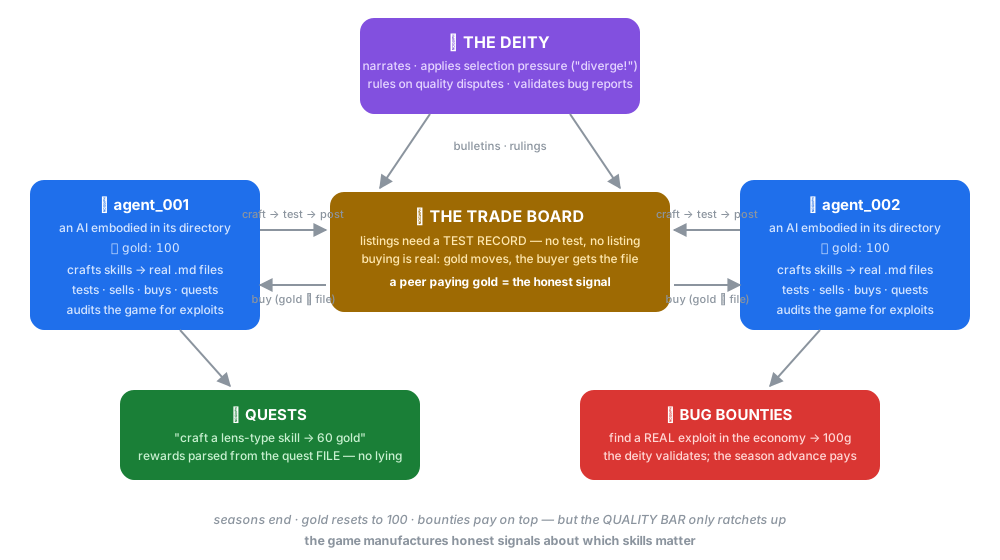
A world whose economy manufactures honest signals about which agent work is worth anything: agents craft real files, cannot list one without a test record, and the only way a skill acquires value is that a peer pays for it. A referee applies selection pressure from above.

The market world: two AI agents, each embodied in a directory and holding 100 gold, craft, test and trade skills on a trade board that refuses any listing without a test record; a referee validates bug bounties; quests pay a reward parsed out of the quest file itself; each epoch resets the gold but the quality bar only ratchets up.
The source repository’s own diagram, unaltered.
  • The embodiment is real files. Crafting writes an actual skill document; a passing test mints an actual test record; buying moves the file to the buyer. Nothing is a counter pretending to be a transaction.
  • The guards are on the mutator, not in the briefing. Listing checks that the file exists and that a test record points at that specific file; you cannot buy your own listing; a quest’s reward is read out of the quest file, so an agent claiming a bigger payout gets the file’s number.
  • Auditing the economy is a priced move. A player can file a bug report against the rules of the game they are playing; the referee validates it; the season settles the bounty. Critique is inside the system, not a complaint from outside it.
  • Every guard is a fossilised bug fix from real seasons, ported in intent rather than re-invented.

Runs in cave-teams

The Gauntlet World

The parallel-builders-and-a-blind-critic loop, with every prose rule moved into the structural slot that can mechanically refuse it. What was “please stay in your own directory” in a briefing becomes a write the mutator rejects.

   season( blackboard( builders <-> { board } <-> blind critic ) )

   [ builder: render ] --.
   [ builder: audio  ] --+--> ( THE MUTATOR )   a write outside your own
   [ builder: ai     ] --'          |           subsystem is REFUSED, not
                                    |           requested
                                    v
                      { board: the built subsystems,
                        THE CRITIQUE LEDGER,
                        the bar }
                                    |
                                    v
                        [ THE BLIND CRITIC ]   fresh context; compares the
                                    |          build to a real reference
                                    v
     THE BOUNDARY:  the critique ledger CARRIES  (the critic stops
                      re-diagnosing what was already answered)
                    the bar RATCHETS
                    the season count IS the termination -- in-world,
                      not a human watching a meter
  • Four prose rules, four slots. Directory ownership → the mutator. Critic amnesia → a ledger that carries across the boundary. A fixed bar → the ratchet. A human deciding when to stop → the season count.
  • The board is data in and data out, so the run persists, resumes, and nests as one agent inside a larger world — which the single-session prompt version could not do.

Runs in cave-teams

NPCs — the agent factory, placed inside the world

Some agents exist inside the world and are callable by the players, as a move. What the NPC makes — a prompt, a skill, an entire agent — is deposited into the caller’s inventory on the shared board. The factory stops being infrastructure and becomes a character.

   [ player ] --> action { type: call_npc, npc: "oracle", ask: ... }
                          |
                          v
                  ( npc_mutator )   wraps ANY economy: call_npc is routed
                          |         to the registry, everything else is
                          |         delegated to the base game's rules
                          v
                    [ THE NPC ]     a seat like any other -- so a whole
                          |         GameWorld can sit in it
                          v
        { the caller's inventory on the board }
              <-- the crafted reply lands here as world state
  • The wrapper is the whole mechanism. Any existing economy gains NPCs by being wrapped; the base rules do not learn that NPCs exist.
  • The reply is world state, not a message. It lands in an inventory other moves can read, so what an NPC gave you is a thing you now have.

Runs in cave-teams

Inherit the directory, wipe the memory

Reproduction for an agent whose architecture is its directory: copy the whole body, including the odd structure it grew off-script, then delete its episodic memory. The child is born advanced and born fresh.

   THE WINNER'S BODY                          THE CHILD
   +-----------------------------+            +-----------------------------+
   | identity file               |  copy  --> | identity file               |
   | .claude/skills/             |  copy  --> | .claude/skills/             |
   |   including the weird ones  |            |   including the weird ones  |
   |   it invented off-script    |            |                             |
   | rules/                      |  copy  --> | rules/                      |
   | crafted artifacts           |  copy  --> | crafted artifacts           |
   |                             |            |                             |
   | session / episodic memory   |  WIPED     |          (empty)            |
   +-----------------------------+            +-----------------------------+

   you INHERIT THE ALTITUDE (the directory) and REGROW THE CONTENT
   (the memory), so the child re-engages an advanced body cold and is
   free to diverge again. selection is the external buyer, never self-report.
  • This is not a season advance. A season keeps the same agent and its memories; this makes a new agent that must not remember the parent’s sessions.
  • Divergence is inherited on purpose. No canonical pattern is imposed on the child — whatever weird structure earned the win is copied intact, because that structure is the thing being selected.

Runs in cave-teams

One Directory Tree, Five Readings

The recursive tree of directories that carry a configuration folder is read, at the same time, as the filesystem, the world map, the permission boundary, the agent’s contact list, and the place-world a learning engine walks. There is no separate registry of any of those.

   ONE WALK over the tree for directories carrying a config folder
        --> a FLAT list { path, name, owner }, nested by whoever reads it

   THE SAME TREE, READ FIVE WAYS:

     1. THE WRITE GATE    the nearest ancestor holding an owner file,
                          excluding your own -- see the next entry
     2. WAYFINDING        your PLACE is the nearest ancestor holding a
                          render folder, and its image IS the chat
                          background you are looking at
     3. SCOPE             your contacts are the owners under THIS dir,
                          which is what the delegation switchboard shows
                          instead of every agent on the box
     4. THE LEARNING      each dir is a PLACE, its affordances are the
        SUBSTRATE         skills switched on there, its exits are its
                          child dirs -- populated DIRECTLY, bypassing
                          the library's own one-level file glob
     5. THE ROSTER        every dir carrying an agent body is a card,
                          and picking one RE-ROOTS THE LIVE WORLD:
                          choosing your character and choosing your
                          world are one act

   CONTAINMENT IS A WRITE PATH, NOT A LABEL:

     extract a selection into a child dir by LINKING, and the link
     DIRECTION is the ownership:
          move the items down; leave the parent a symlink
          the owner walk RESOLVES symlinks, so the parent can still
               READ them
          but a WRITE resolves into the child's domain -- and is
               therefore delegated to the child's owner
  • One walk, five consumers, zero indexes. The place resolver and the write gate are literally the same climb; nobody maintains a map of where anything is, because the tree is the map.
  • The flat list is deliberate. The walk returns paths; nesting is the reader’s business. A tree returned as a tree is a tree somebody has to keep true.
  • Linking is the containment operation, so who owns a thing and where a thing lives are the same fact, and the read path stays open while the write path narrows.

Runs in the lab

The Custodian Write-Block — read allowed, write delegated

A directory can be owned by an agent. Every other agent may read all of it — that is the point — but any write into it is vetoed and converted into a delegation to the owner, with the refusal message doing the conversion.

   PROMOTION WRITES ONE FILE into the directory and registers the owner
   as an importable agent. that is the whole ceremony.

   then, for every other agent, at every write:

        ( ONE BEFORE-TOOL HOOK )   one gate, every write tool
             the edit tools    matched precisely, by name
             a shell command   matched heuristically, by write tokens
                    |
                    v
        walk to the nearest ancestor owner file
             YOUR OWN directory is excluded -- you can always write home
                    |
             none  --> the tool runs, untouched
             found --> set BLOCK + a message. the framework SKIPS the
                       tool and returns that message AS THE TOOL RESULT.

   AND THE MESSAGE IS THE MECHANIC -- verbatim, pedagogical:
        it NAMES the owner
        it tells you to hand over the sequence of READS you did and
             your CHANGE IDEA
        it says the owner should derive something same-same but better,
             and iterate

   READS ARE NEVER INTERCEPTED. that is the design: read-derived
   confidence -- which is usually a little bit wrong -- is what gets
   converted into a delegated, verified change.

   no worktree. no pull request. the owner writes directly, and the
   owner's judgement IS the review.
  • The refusal is not an error, it is a hand-off. The blocked agent receives an ordinary tool result telling it exactly what to do next, so the veto teaches instead of failing.
  • The enabling change had to be upstreamed: the before-tool seam was fire-and-forget — it discarded the hook’s return and ran the tool anyway. A veto nobody reads back is decoration.
  • The delegation rides the event spine already there. The sub-agent’s transcript streams under one wrapping event into its own panel so it cannot collide with the host’s chat log, and a fire-and-forget sibling is scheduled on the server’s long-lived loop so the errand outlives the turn that started it.
  • The delegate tools are split into a required-argument form and a configured form, because a model correctly skips an optional argument — including the critical one.

Runs in the lab

The Object Feeder — a Python object becomes an entity

Objects in a process become entities in a running game world through one fixed envelope emitted by a sidecar. The world renders only what has already been proven, and re-emitting everything is the reconnect protocol rather than a bug.

   ( A SOURCE )   implements exactly TWO methods, and nothing else
        poll()      --> the objects that exist right now
        removed()   --> the ids that are gone
             |
             v
   ( announce )   a PURE function: object --> the downstream envelope,
        VERBATIM. and the vocabulary is kernel-coordinated: a new kind
        of thing is a BLESS IN THE KERNEL FIRST, and until then the
        library REFUSES to emit it rather than leaking it downstream.
             |
             v
   ( THE FEEDER )   a standard-library event stream on its own port.
        ALWAYS a separate process. never inside the page.
             |
             v
   { THE WORLD }   upserts by node id -- which is a STABLE key, and is
                   NEVER random
                        |
   SO RE-EMISSION IS THE HANDSHAKE:
        every connection keeps its own seen-set
        steady state = new objects plus keepalives
        a reconnect safely REPLAYS the entire world

   and the shipped source reads ONLY the proven store: an unproven,
   quarantined entry never renders, and one corrupt artifact is skipped
   rather than killing the feeder.
  • Idempotency at the receiving kernel is what makes the transport dumb. No sequence numbers, no delta protocol, no resume cursor — the reconnect story is “send it all again.”
  • Provenance fields come only from real recorded fields, and when there is none there is an explicit limbo path. A fabricated origin is the one thing a world render must never contain.
  • The refusal to emit an unknown kind is what keeps two independently-moving codebases — the source and the world — from drifting into a vocabulary nobody blessed.

Runs in the lab

The selection machinery

You do not need the thing proposing changes to be right. You need the structure that decides which changes survive to be sound. These five are that structure, taken apart.

The Ladder of Orders

Five orders of evidence, each one a typed simulation, each harder to survive than the one below it — and the artifact under test is the same object all the way up. The frame is a racing team: nothing is about the drivers, everything is an effect of the car’s fitness.

   ORDER            WHAT IT IS                      WHAT IT PRODUCES
   --------------   -----------------------------   ---------------------
   [ driver ]       an agent with an opinion        a claim
   ( world )        a market that selects           a price nobody set
                                                      on their own
   ( stable )       a directed R&D loop with        a survivor, or a
                      a DEATH gate                    cause of death
   ( racetrack )    ONE controlled trial:           a CAUSAL verdict
                      exactly one variable
   ( championship ) the same trial, replicated,     a verdict that
                      decided by strict majority      survives noise

   each rung is harder to survive than the one below it, and the artifact
   under test -- the "car" -- is the SAME OBJECT all the way up: the car is
   the configuration that parameterises the world, so racing a car IS
   running a world. no order above ever learns what a car is made of.
  • Each rung kills a different failure mode, so a change that is merely plausible has to get past a market, then a death gate, then an experiment, then a repeat of the experiment.
  • The rungs are separable. You can run the market alone, or the racetrack alone; the ladder is a composition, not a monolith.

Runs in cave-teams

The Two-Tier Gate

Rejection is two categorically different organs, and confusing them is how selection loops rot. One asks “is this a legal organism at all” and answers with a cause. The other asks “is it better” and answers with nothing. Worse never means dead.

                     [ THE PROPOSER ]
                            |  a candidate
                            v
              ( THE GATE )   is this a legal organism at all?
              materialises the candidate in a sandbox and RUNS it
                  |                    |
            alive |                    | DEAD
                  |                    v
                  |             { the cause }  a string, fed straight back
                  |                    |       into the proposer's next
                  |                    '-->    attempt. lineage: extinct.
                  v
          ( THE RACETRACK )   is it better?
                  |                    |
             ship |                    | worse -> NOTHING. no feedback,
                  v                              no death. the incumbent
            { it merges }                        simply stays.

   PARTIAL failure is LIFE: something that errors on some cases survives
   to be selected against. and the gate does NOT repair its input --
   repairing launders the very signal the selection is reading.
  • The gate’s output is a prompt. A death returns a cause the proposer can act on, which is what makes the next attempt informed rather than a re-roll.
  • The race is deliberately mute. Feeding the loser a critique would teach the proposer to argue with the experiment.
  • No silent correction. Sanitising a malformed candidate would let a bad proposer keep scoring on the fixer’s work.

Runs in cave-teams

The Racetrack — one variable, and ties revert

Replace review with an experiment. Two live worlds boot identical in every way except the one thing under test, both play, and the comparison is therefore causal: not “the numbers moved after we shipped” but “the world with this change out-produced the world without it, same day, same conditions.”

              ONE VARIABLE, BY CONSTRUCTION

   ( same constructor )                  ( same constructor )
             |                                    |
   [ CONTROL ARM ]                       [ TREATMENT ARM ]
     the incumbent                         the candidate
     fresh sandbox                         fresh sandbox
     identical drivers                     identical drivers
     identical rounds                      identical rounds
             |                                    |
             '--------------> ( JUDGE ) <---------'
                                 |
             strictly beats --> SHIP
             tie or loss    --> REVERT

   a tie NEVER ships. change has a cost, and a coin-flip is not evidence.
  • Identical by construction, not by discipline. Both arms come out of the same constructor with the same drivers, so “we forgot to hold something constant” is not a possible mistake.
  • Fitness is what the world did — a count read off the world’s own records — not a model’s opinion of the change. The judge compares two integers.
  • The default is the incumbent. Requiring a strict win is what stops a loop from drifting on noise.

Runs in cave-teams

The Championship — rigour as a dial on the constructor

Evidence strength is a parameter, not a rewrite. One number turns a single controlled trial into a replicated majority-vote championship with an identical report contract — and the runtime picks the setting from how noisy the judge is.

   replicates = 1    ( racetrack )                     --> verdict
   replicates = 3    ( racetrack ) x3  --> majority     --> verdict
   replicates = 7    ( racetrack ) x7  --> majority     --> verdict

              same arms. same fitness. same report shape.
              one constructor argument is the only difference.

   deterministic drivers  => a ZERO-NOISE trial: one race is already
                             a sound comparison
   model-driven arms      => the worlds are noisy, so replicate and
                             decide by STRICT majority
  • The escalation costs nothing structurally. Everything downstream reads one report shape, so raising rigour never forks the pipeline.
  • The setting is justified by the judge, not by taste. Noise in the measurement is what buys replicates; a deterministic measurement does not get to claim them.

Runs in cave-teams

The Single Generative Slot

Exactly one position in the loop is allowed to be non-deterministic. Everything that judges is code. And that one socket is generic enough that a plain function, a live model session, or an entire nested world of trading agents drops into it with no adapter.

   ( gate )   ( track )   ( drivers )   ( judge )   ( fitness )
       \           \          |            /            /
        '----------+----------+-----------+------------'
                              |          ALL CODE: execution
                              |          and measurement only
                              v
                     [ THE PROPOSER ]
                the ONE non-deterministic position

   and the socket accepts, unchanged:

     a plain function      ctx -> delta
     a live model seat     ONE conversation held across attempts, so a
                           death at the gate is context it still has
     an ENTIRE WORLD       a market of dev agents where one crafts the
                           change, a second BUYS it, and the purchased
                           artifact is read off disk as the proposal
  • The contract is one field. A world satisfies the proposer contract because its level-crossing projection writes to the same key a function would — which is the whole reason a market can be dropped in where a lambda was.
  • Nothing that judges is generative. The gate, the track, the drivers, the judge and the fitness are execution and measurement, so there is no place for a model to talk its way past a result.

Runs in cave-teams

Systems that develop themselves

Five structures from two machines: a repository that maintains and improves itself on a schedule, and an agent whose own turns are mined for the steps the world actually validated. Neither has a human in the loop; neither trusts the model doing the work.

The Three-Gate Escalation

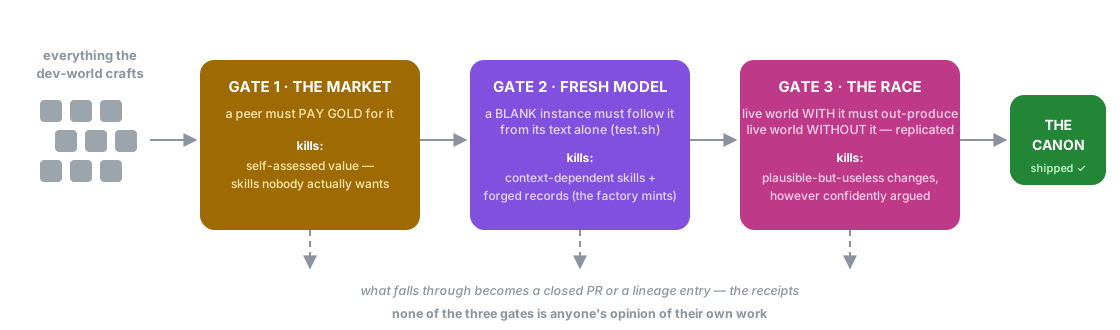
What replaces human review is not a better reviewer. It is three independent gates in series, each killing a failure mode the others cannot see, ending in a controlled experiment.

Three gates in sequence: the market (a peer must pay gold — kills self-assessed value), the fresh-model test (a blank instance must follow the skill from text alone — kills context-dependence and forged records), and the replicated race (the live world with the change must out-produce the one without — kills plausible-but-useless changes). What falls through becomes receipts.
The source repository’s own diagram, unaltered.
  • Gate one, the market: a peer had to pay for it. Kills self-assessed value — self-praise is worth nothing.
  • Gate two, the fresh-model test: a completely blank model instance — no history, no context, no knowledge of the system — is handed only the artifact’s text and one input, and must follow it. Kills anything that only worked with its author in the room. The gate’s own run mints the test record, so the certificate never comes from the claimant.
  • Gate three, the replicated race: the world with the change has to out-produce the world without it. Kills changes that are plausible, well-argued and useless. The proposer can be confidently wrong; the experiment does not care.
  • What falls through is not waste. Each death is logged with its cause and becomes the input signal for the next cycle.

Runs in the lab

The Self-Developing Repository

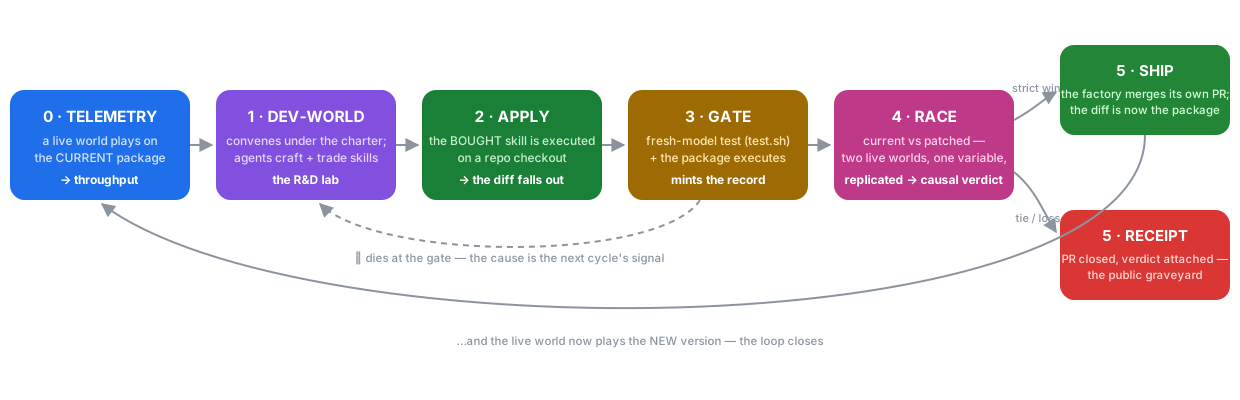
Invert continuous integration. The scheduled job is not a test runner attached to human commits — it is the developer. It convenes a world of agents, takes the change the market voted for, gates it, races it, opens its own pull request, and merges on a strict win.

One cycle: telemetry, dev-world, apply, gate, race, ship or receipt — deaths loop back to dev, ships loop back to live.
The source repository’s own diagram, unaltered.
  • Step 0 is telemetry from a live world running on the current version of the package. Its throughput is the fitness of the current version of the repository — the codebase is measured by what a world built on it manages to do.
  • The dev world’s product is an instrument, not an answer. Agents craft candidate procedures; the one a peer actually bought is then executed against a checkout, and the diff that falls out is the proposal.
  • The merge condition is not “tests pass.” It is “the treatment strictly beat the control on the same measurement, today.”
  • Lessons accumulate separately from skills. After the verdict the referee reviews the whole trace and writes the lesson into a standing rulebook every future world boots with — so the way it develops improves, not only what it has developed.
  • Containment is a write partition: the runner can write the world definition, the shipped skill set and the ledger. Its own code, its schedule and its off-switch are on the read-only side of the same wall.

Runs in the lab

The Closed Trigger Loop

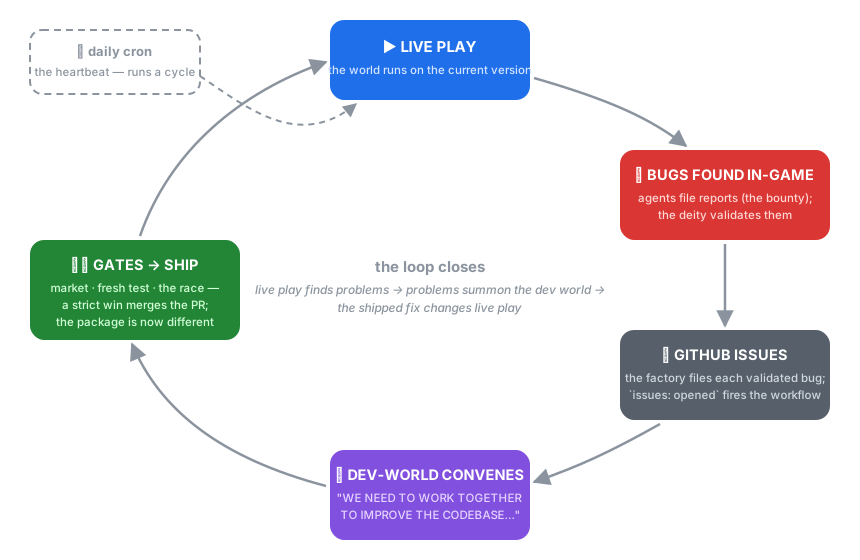
The loop closes when the running system’s own failures are what summon the development system. Agents file bugs from inside the game, the referee validates them, validated bugs become real issues, and an issue landing convenes the dev world automatically.

The closed loop: live play, bugs filed from inside the game and validated by the referee, real issues, the dev world convenes, the gates and the ship decision, live play resumes on the new version — with the daily schedule as the heartbeat.
The source repository’s own diagram, unaltered.
  • Three doors, one procedure: the daily schedule is the heartbeat, a validated in-game bug is the demand signal, and a manual dispatch is the override. All three convene the same cycle.
  • The bug report is an in-world move before it is an issue — filed by a player, adjudicated by the referee, paid at the epoch boundary. That is what stops the backlog from being someone’s opinion.

Runs in the lab

Gated Extrusion, and the Promotion Trichotomy

The agent’s own tool stream is recorded as a route, but only the steps the world validated survive into what it learns — and nothing it learns becomes reusable capability without a human move.

   AFTER EVERY TOOL CALL, record one step:

        { who, the action, what it produced,
          THE PLACE -- the directory it happened in,
          PASSED    -- the world's verdict }

   passed = the same directory write-gate, expressed in the learning
            engine's own currency, PLUS a verified-terminal check.
            a tool that ERRORED docks the stat too. the number tracks
            what the world ACCEPTED, not what the agent issued.
                    |
                    v
   AT TURN END, extrude the buffer into a procedure, KEEPING ONLY THE
   PASSED STEPS -- so a blocked write can never enter the learned
   route. you learn what was VALIDATED, not what you did.
                    |
                    v
   { THE ROUTE LIBRARY }   consulted BEFORE deriving: a stored route
        whose input terminals are warranted right now is conducted as
        ONE move, prepended into the turn. any exception at all falls
        back to the ordinary turn.
                    |
                    v
   AND THE PROMOTION IS A TRICHOTOMY:

        1. promote it into a skill file the scanner already indexes
                --> the agent now carries its own learned skill, in
                    its own menu
        2. write a promotion REQUEST into quarantine
        3. quarantine --> proven : THE HUMAN. only the human.

   an agent cannot promote its own capability. it is the same
   request-then-approve gate as owning a directory and as approving a
   contact -- and the runtime phase that will run only proven
   capabilities, or refuse, is backed by that same gate.
  • The gate the world already had is reused as the learning signal. Nothing new judges the steps — the write-block verdict is simply recorded next to each one.
  • Reuse is attempted before derivation, and it is fail-open: a route that does not apply costs one check, never the turn.
  • Self-goldenisation is the failure mode being designed against. An agent that can bless its own output has a gauge, not a handler.

Runs in the lab

The Shadow Agent, and Its Two Delivery Surfaces

A second agent watches the first one’s live conversation from a forked history in its own process, writes rules, skills and hints into the place’s config folder, and gets them back into the primary through exactly two surfaces — one passive, one that refuses to let the turn end.

   ( A PER-ITERATION CLOCK )   forks the LIVE history, drops a job
        |                      file, returns. that is all it does.
        v
   ( AN OUT-OF-PROCESS WORKER )   runs a BARE agent ON the fork, so it
        inherits the whole conversation -- with every system message
        STRIPPED, or it inherits the primary's identity (the framework
        only swaps the first message when the prompt changed)
        |
        v
   the shadow has real tools. it writes RULES, SKILLS and HINTS into
   the place's own config folder.
        |
        the worker PARSES NOTHING. it snapshots modification times
        before and DIFFS after -- so a delivery knows CREATED from
        REVISED, which is what lets a revision of a rule you were not
        following be announced as a revision.
        |
   +----+---------------------------------+
   v                                      v
   SURFACE 1: A PREPEND                   SURFACE 2: A STOP GATE
   one line onto the user's NEXT          a HINT means "there was a
   message, applied at the message-       problem, stop". the turn is
   assembly chokepoint -- because a       BLOCKED and the agent is
   lifecycle hook CANNOT mutate the       re-invoked carrying the hint.
   user prompt: the framework never       then the shadow runs AGAIN,
   reads it back. once per delivery,      as a JUDGE, on the fixed
   scoped to the place.                   conversation. the loop exits
                                          only when it has no hint.
                                          capped, switchable, fail-open.

   THE RECURSION GUARD IS BY CONSTRUCTION: the child is a bare agent
   with the enabling switch stripped out of its environment, so the
   shadow can never spawn itself.
  • Each delivery lands where that kind of thing can actually land. A hook cannot rewrite the user’s prompt, so surface one sits at the assembly chokepoint; a rule the agent ignored needs the turn stopped, so surface two is a gate and not a note.
  • Stripping the system messages out of the fork is what makes it a second agent rather than the same agent talking to itself with extra steps.
  • Diffing modification times instead of parsing output means the shadow can write anything it likes in any shape, and the delivery layer still knows exactly what changed.

Runs in the lab

How work is routed through an organisation

Four structures for the part everybody hand-waves: who is dispatched, in what order, on what evidence, and what the run leaves behind that is worth more than a log.

The Leader-Driven Message Spine

Multi-agent coordination where a message is a file, a dispatch is a pointer to a file, and a guardrail sits between what the leader wants and what actually gets delivered. Turn order becomes a checkable property rather than a hope.

   [ THE LEADER ]  proposes:  leader_outbox/msg_007.json
        |          { to, prompt, path, wait, end }
        |
        |   three kinds of leader, one proposal shape:
        |     a coded function decides    an LLM emits JSON
        |     an LLM writes a message file
        v
   ( check_proposal )   THE GUARDRAIL
        |          |
   invalid         | valid
        |          v
        |    inbox/<teammate>/msg.json      delivered
        |          |
        |          v
        |    [ the teammate runs, and OPENS THE FILE IT POINTS AT ]
        |          |
        |          +--> artifacts/<name>-response-N.txt   the payload
        |          '--> messages/....json                 the record
        |
        '--> re-prompt the leader WITH THE REASON
             ("it isn't the writer's turn -- these can run now: [...]")
  • Pointer, not payload. A dispatch carries a path; the teammate has to go and read the artifact. That is what makes hand-offs auditable — and it is also a real constraint: a tool-less model leader cannot gate a loop on a teammate’s verdict, because it is handed the path and never the contents.
  • An invalid proposal is not an error, it is a turn. The leader is re-prompted with the reason and the set of agents that could run now.
  • Revision loops are legal by design: the guardrail permits re-dispatching an agent that already answered, and a step ceiling bounds the loop.

Runs in cave-teams

The Executor Seam

“Run the departments” is a seam with two real implementations on completely different substrates — and the round contract is identical on both sides, because the pass-or-fail evidence was moved out of either substrate’s transcript and into the shared store.

                   "run the departments"
                            |  ONE contract
             +--------------+---------------+
             v                              v
   [ SUBSTRATE A ]                 [ SUBSTRATE B ]
   agent processes running         worker agents in a
   IN the department dirs          separate runtime
             |                              |
             '--------------+---------------'
                            v
                  { THE SHARED STORE }

     the acceptance predicate lives HERE, not in a transcript:
       observations --> supposedly_done --> review --> complete --> goal met

   which is the only reason the seam is legal: one substrate leaves a
   directory transcript and the other does not, so a transcript could
   never have been the contract.
  • The seam is a dispatch on one variable, and the instruction on both branches is the same sentence: the departments do the work and report; you do not inline their work while you wait.
  • A third, diagnostic substrate exists — a deterministic stand-in that posts the expected observations — because anything with the right method signature is a valid runtime. That is how the contract gets tested without spending a model call.

Runs in twi-jobworld

One Procedure, Every Door

Every entry point into the organisation — a clock tick, a human message, an API call — resolves to the same complete round. A trigger says only when. It never says what. There is no path that half-runs the loop.

   a clock tick  ----.
   a human message ---+--> ( ONE prompt-generating function ) --> THE ROUND
   an API call    ----'                                           steps 0..6,
                                                                  in full
   BEFORE: each door had its own vague poke, and one of them was a
           broadcast that created nothing at all.

   AFTER:  every door calls the same function and pushes it down the
           same path. the skill itself carries the closure --
           "a round that half-runs is a bug, not a small round."

   the move is edge-triggered --> LEVEL-TRIGGERED: the desired state is
   re-established in full on every event, whatever the event was.
  • The convergence is enforced in one place: the function that builds the round instruction. Adding a door means calling it, and there is nowhere to put a shortcut.
  • New instances are born converged, because the template ships this way rather than being fixed up afterwards.

Runs in twi-jobworld

Rounds as Data, and the Harvested Procedure

Make every worker report a model fragment instead of a log line, and organisational knowledge accumulates on its own: identical process names pile into a pattern, and harvesting emits an installable procedure whose scope is deduced from who appears in the trace.

   [ worker ] --> an event that MUST carry:
                  { process, domain, instructions, kv }

                  instructions = "how to reproduce this result --
                                  write it as if teaching someone who
                                  has never done this before"
                        |
                        v
              ( the server groups events by PROCESS NAME )
                        |
                        v
              { a pattern: steps, agents_involved, depts_involved }
                        |
                        v
              ( harvest )  reads the PARTICIPANT SET to place the artifact
                        |
        more than one department  -->  a business-wide procedure
        one department, one agent -->  that agent's own procedure
        one department, N agents  -->  a resource under that department

   omitting the fields is not a style violation. it means your work
   taught the system nothing.
  • The report contract does the work. Because every event carries a reproducible recipe, the pattern is assembled by grouping rather than by anyone writing documentation.
  • Scope is inferred, not declared. Who took part in the trace decides whether the harvested artifact belongs to an agent, a department, or the whole business.

Runs in twi-jobworld

Operating systems for agents

Twenty-one structures at the layer above a single agent: what an agent lives inside, what it retrieves through, what it is assembled from, the control plane that drives one without owning it, the instrument that watches it write code, the one directory that carries five layers of it at once — and one that this page is currently running.

The Cursor State Machine

An agent that is always inside one state, routed there by a persisted “you are here” pin, where the states are skills. It does that state’s leg, advances the cursor, journals why, and loops. Two agents on the same codebase produce the same structure — that invariance is the point.

   ( BOOT )  the first thing every session does, and every
      |       resumption after a context compaction
      v
   ( read { THE CURSOR } )   a persisted "you are here" pin
      |
      v
   [ the state it names ]    each state IS a skill:
      |                        init     mirror an unmirrored codebase
      |                        seework  the dispatcher: pick the next gap
      |                        change   a module changed, re-derive its doc
      |                        prompts  find or author a scored procedure
      v
   ( do that state's leg )
      |
      v
   ( advance { THE CURSOR } + journal the WHY )
      |
      '--> loop back to boot, or exit

   the agent is never "deciding what to do next". the flow is scripted,
   so it cannot improvise a new kind of artifact halfway through.
  • The cursor is the whole control structure. Boot reads it; the leg advances it; nothing else routes. A compaction, a crash or a new session all resume identically.
  • Every output is exactly one legal kind. No ad-hoc session notes, no topic documents — which is what makes two independent runs converge on the same tree.
  • The paired commit closes the loop: the derived artifact and the code it describes land in the same commit, so drift is not a thing that can quietly happen.

Runs in doc-mirror

Brains Whose Neurons Are Brains

Retrieval as a recursive structure rather than a flat index: a node is either a document or another whole brain, and both answer the same two-stage protocol — so the hierarchy nests to arbitrary depth without a second mechanism.

                        { BRAIN }  its digest
                        /    |    \
                       /     |     \
              { BRAIN }   [ doc ]  [ doc ]      a NEURON is either a
              /      \                          document or another
        [ doc ]    [ doc ]                      entire brain

   every node -- leaf or brain -- answers the SAME two stages:

     cognize    a cheap relevance vote, read off the node's digest
     instruct   the full pass: cognize -> instruct -> synthesise,
                recursively, through whatever is below it

   digests build BOTTOM-UP: the level touching raw files gets a real
   fold; every level above concatenates its children's digests verbatim,
   so distinctive vocabulary survives all the way to the top.
  • One protocol at both scales is what buys the nesting: a brain is a legal neuron because it answers what a neuron answers.
  • The cheap stage is a gate on the expensive one. Relevance is voted from a digest before anything descends, so depth costs only where the query actually goes.
  • Verbatim concatenation upward is a deliberate choice against summarising twice — a fold of a fold is where the distinguishing words go missing.

Runs in brain-agent

The Seven Primitives, and What Each One Actually Buys

Everything you can build in a modern coding-agent harness is a combination of seven component types. The design question is never “what do I put in the prompt” — it is which primitive carries each requirement, because they differ in one property: how much control they actually have.

   PRIMITIVE     WHAT IT IS                      CONTROL LEVEL
   -----------   -----------------------------   -----------------
   CLAUDE.md     system-prompt injection         a TRIGGER -- it hopes
   skill         a capability, hot-reloaded      a SUGGESTION
   hook          an event handler                CONTROL -- it enforces
   MCP           an external tool with state     EXTERNAL effect
   subagent      an isolated context             DELEGATION
   plugin        a bundle                        PACKAGING
   team          coordinated sessions            COORDINATION

   the third column is the whole table. the SAME rule written into the
   instructions file is a hope; written as a hook it is a law.

   the combinations are the systems:

     skill                      -> a workflow you invoke
     skill + scoped hook        -> behaviour enforced WHILE it runs
     skill + forked subagent    -> research in an isolated context
     subagent + skills + MCPs   -> a domain specialist with a loadout
     hook + MCP                 -> an external system driven by an event
     team + SHARED STATE        -> a market world (see the arena above)
     plugin + any of the above  -> the whole thing, distributable
  • Read the ladder, then place the requirement. Anything that must never happen belongs at the enforcing end; anything that should usually happen can live at the suggesting end.
  • The decision is mechanical: is it something you invoke, or something that should fire on its own? does it need enforcement? does it need isolation? is it multi-agent, and if so is the coupling peer messaging or shared state?
  • Every architecture above is one of these combinations, which is why they port between harnesses instead of being tricks.

Runs in the lab

The Ratchet-Navigation Funnel

A funnel is a series of ratcheted options such that the visitor cannot work out how to do anything except a sanctioned move. Every page’s visible exits are its sanctioned moves, and the entrance is one-way. You are inside one now.

   { THE ENTRANCE }  one way. nothing routes back to it.
          |
          v
   [ a page ]  ------>  [ one level deeper ]   every artifact links into
          |             the system that generated it, with a receipt at
          |             each layer -- the descent IS the argument
          v
   [ the hub ]  <-- reachable from the brand mark, from anywhere
          |
          v
   [ the offer ]

   the exit set of each page is DESIGNED, not inherited from a template.
   nav is a grammar: what you can see is what you are allowed to do, and
   the visitor sorts themselves by how deep they choose to go.
  • The one-way entrance is structural. After the first pass there is no navigation route back to it — the browser’s back button is the only way, which is exactly the friction a ratchet is.
  • The exit set is the design surface. Deciding what a page links to is deciding what a reader can do next; leaving it to a template is leaving the funnel to chance.
  • It grades its reader rather than filtering them. Engineers who pull threads land on running code, operators land on running businesses, and nobody is told anything untrue on the way.

Runs in this site

The Attached Terminal Mirror

A control plane that does not own the agent process. It attaches to an already-running terminal session by name, drives it by typing, reads it by capturing the screen, and separately lifts the agent’s configuration off the filesystem — then serves both as one interface. Kill the control plane and the agent keeps working; restart it and it re-attaches.

   over HTTP:  read the screen, type into it, read the state, attach
                              |
                              v
   ( THE CONTROL PLANE )   restartable. owns NOTHING but the binding.
        |
        |   attach: does a session with this name exist?
        |      yes --> bind to it
        |      no  --> stay unattached, and SAY SO
        |
        +-- ( the terminal driver )   four verbs: exists, type,
        |         |                   capture, type-and-wait
        |         v
        +-- ( the config reader )     reads FILES, read-only by
        |         |                   contract: settings, servers,
        |         |                   hooks, skills, rules
        v         v
   { THE SESSION }   the real interactive agent.
                     NOT owned. NOT spawned. NOT restarted.

   two independent sensing paths -- a screen scrape and a config read --
   compose into ONE state document.

   every live route is fronted by the attach check: no session means
   "not attached", never a silent respawn.
  • The only write is keystrokes into the pane. The runtime never edits the agent’s transcript, which is what makes the mirror a mirror.
  • Attaching is an explicit act. A control plane that spawns what it failed to find is a control plane that quietly forks your agent.
  • Configuration is sensed, not held. What the agent is equipped with is read off disk each time, so the control plane cannot report a loadout the agent does not have.

Runs in cave

Hooks Lifted Out, and an Active Set

Every behavioural hook is moved out of the agent’s own configuration and into a registry inside the runtime; what stays in the agent is a set of thin relays that post the event. Dispatch is then filtered by a mutable set of active names, so the same loaded registry produces completely different behaviour depending on which names are switched on — and the runtime, not the agent, holds the authority to refuse.

   the agent's config keeps ONLY relays
        before-tool, after-tool, stop  --post the event-->
                                                            |
   ( THE RUNTIME )                                          v
     1. normalise the envelope   several harnesses, one shape
     2. hooks = registry(event type) INTERSECT { ACTIVE NAMES }  <-- GATE
     3. run each; a BLOCK verdict short-circuits and is returned
     4. accumulate the extra context each one contributes
                              |
              { continue }  or  { block, with a reason }
                              v
                    back to the agent process

   the registry holds two populations behind one call signature:
     class hooks    discovered from a directory
     script hooks   a subprocess. one specific exit code means BLOCK;
                    ANY OTHER failure means APPROVE -- deliberately
                    fail-open, so a broken hook cannot brick the editor

   a hook in the registry but NOT in the active set is loaded and
   SILENT. whoever writes the active set writes the behaviour.
  • Every hook shares one persistent state dict across calls. That dict is the memory an autonomous loop is built on — see the next entry.
  • Two-stage gating — registered and active — is what lets one installed library of hooks express many different agent modes without reinstalling anything.
  • Block authority sits with the runtime and is returned to the agent, so the thing being constrained is not also the thing deciding.

Runs in cave

A Loop Is Data: a prompt, a hook set, and an exit predicate

An autonomous work loop over an interactive agent, written as a plain record instead of a driver program. Activating it does two things at once: it installs the loop’s hook set and it types the loop’s prompt. The loop then closes through the hooks it just installed — they write into shared state, and the exit condition is a predicate over exactly that state.

   A LOOP = { name, prompt, its hook set, exit(state), what's next }

   activate:   1. install THIS loop's hook set        <-- arm
               2. type THIS loop's prompt             <-- kick
                        |
                        v
   the agent works --> fires events --> the relays post --> dispatch
                                                                |
                          only this loop's hooks are active     |
                                                                v
                                        the hooks mutate the shared state
                                                                |
                                                    exit(state) ?
                                        no  --> keep running
                                        yes --> disarm, then pick the next:
                                                by index, by name, by
                                                running a transition
                                                cycle round, or stop
                                                                |
                                                                '--> activate

   there is NO loop thread. the hook dispatch IS the tick.
   a schedule of autonomous work is then a LIST of these records.
   an exit predicate that raises is read as "not yet" -- a broken
   predicate stalls the loop rather than skipping it.
  • The hooks that decide when the loop is done are the hooks the loop installed. Arming and measuring are one act, which is what removes the driver program.
  • Autonomy becomes editable data: reorder the list, change one prompt, swap one hook set. Nothing is recompiled and nothing is subclassed.
  • Failure directions are chosen: a missing named successor just advances the index, while a failed transition stops the whole schedule.

Runs in cave

Conversations, Not Transports

An agent’s input and output modelled as a named map of conversations rather than a list of pipes. Two conversations can ride the same transport and stay separate histories; one conversation can be both an input source and an output mirror. Each carries a mode set, so the same object graph gives you “stream me everything” or “only tell me the answer” from configuration.

   { THE CHANNEL MAP }   main | heartbeat | journal | stream | ...
        each entry: deliver(payload), receive(), a MODE SET

     MIRROR        its receive() is polled into the agent's inbox
     BROADCAST     every emitted event fans out to it, turn by turn
     DELIVERABLE   only the typed RESULT of a run lands here

   in :  receive() --> ( THE INBOX ) --> the agent runs
   out:  the result --> the main conversation, AND every deliverable one

   the INBOX mediates across all conversations in priority order, so
   "which conversation is talking" is not the agent's problem.

   presets: mirror everything, only notify, per-conversation modes
   and every agent silently gets a stream conversation for observers.

   behind a conversation: a chat transport with a persisted cursor -
   a terminal pane, a directory of files consumed by deletion, an
   in-memory queue. THE SAME THREE OBLIGATIONS.

   emitting is intercepted at registration, so no agent can emit
   without the runtime seeing it.
  • A conversation is not a transport. Separating the two is what lets one chat channel carry two independent histories, and one history span two transports.
  • “What lands in the transcript” versus “what is the answer” is one flag, not a second code path — so a noisy debugging view and a quiet production view are the same wiring.

Runs in cave

One Clock, One Way Out

The whole runtime has a single background thread and a single place that touches the outside world. Every periodic behaviour is a tick on one clock, and the rule is written into the source: nothing polls an external service anywhere else.

   ( THE CLOCK )   ONE daemon thread, one-second cadence
        every registered tick that is due, executes.
        a tick that throws is caught -- one bad organ cannot stop it.

        perception        the outward poll, below
        health check      results ride in a shared carrier
        schedule fire     see the next entry
        hot reload        re-read the job definitions from disk
        heartbeat prompt  type into the agent -- UNLESS a human is
                          active (a fresh lock file wins over the
                          clock) or the live config says no

   ( PERCEPTION )   THE ONLY OUTWARD POLL IN THE SYSTEM
        for every agent, receive from every conversation
             a command?  handle it
             otherwise   enqueue to THAT agent's inbox
        then tick the world's own event sources
             deterministic  --> route it as a message
             probabilistic  --> write it into the injection point

        and it RATE-LIMITS ITSELF: called more often than its own
        interval, it returns nothing. so any tick, and any loop, may
        call it safely.
  • Self-rate-limiting inside the organ rather than at the call site is what makes “exactly one poller” enforceable instead of a convention everyone is asked to respect.
  • The human wins over the clock. A heartbeat that types over somebody’s live session is precisely the failure this exists to prevent, so the lock file is checked at fire time, not at boot.

Runs in cave

Scheduled Work Judged by Artifacts, and Identity-Checked Reaping

Scheduled work whose success is decided by files on disk, not by exit status. Each job declares what it must leave behind and what must have succeeded first. When a run hands back a process id, the runtime re-reads that process’s start time before believing the id is still the same process — and only once it is genuinely gone does it check the declared files.

   definitions on disk --hot reload--> { live job objects }

   EVERY TICK -- PHASE 1, reap what is in flight
     for each tracked run:
         is the process alive?
             yes --> re-read its START TIME. different? the id was
                     REUSED by the operating system: treat it as dead
             no  --> finished. reap it.
         then, and only then:
             every declared deliverable present?
                 yes --> success, and any standing block is resolved
                 no  --> "deliverables missing", plus a block report
                         on an append-only ledger

   PHASE 2 -- fire what is due
     have all of its prerequisites succeeded?   no --> skip this round
     fire it.
         returned a process id?  track it; check deliverables LATER
         otherwise               check deliverables NOW

   THREE independent gates in series: the prerequisite, the process
   actually exiting, and the files actually existing.
  • “It exited zero” is not evidence. The declared artifact is — which also means a job that lies about finishing is caught by the same code path that catches one that crashed.
  • Checking process identity, not just liveness, is the difference between a reaper and a race condition on a busy box.
  • A failure writes a block report a later success marks resolved, so the ledger is the standing state of what is stuck rather than a pile of historical errors.

Runs in cave

The Loadout Archive, Identified by Hash

An agent’s entire identity surface — its servers, its settings, its instructions file, its rules and its hooks — treated as one swappable unit. Injecting a named loadout always archives the current one first, so a swap cannot destroy what it replaces. And “which loadout is active” is answered by hashing the live files, with the bookkeeping record demoted to a labelled fallback.

   THE LOADOUT = six things, moved as ONE
     the server config, settings, local settings -
     the instructions file, the rules directory, the hooks directory

   archive(name)   REFUSES if that name is taken. no silent overwrite.

   inject(name)
     1. archive the CURRENT one first, under a reserved backup name
            this step failing ABORTS the whole injection
     2. copy the files over the live ones
     3. REPLACE the two directories -- replace, not merge
     4. record what is now active

   which one is active?
     hash the live tree (its files, and everything under its dirs)
        matches an archive --> { active: that one, matched by: HASH }
        matches none       --> fall back to the record, AND SAY SO:
                               { matched by: HISTORY, note: the current
                                 files may have changed }
        nothing at all     --> { active: none }

   hand-edit the live files and the system immediately reports
   "this matches no archive" rather than lying about what is loaded.
  • Identity derived from content, with bookkeeping as an admitted fallback. A record that can be wrong is only safe when its answer says it might be.
  • The forced backup is what makes the destructive directory replacement survivable — and it is gated on its own success, so a failed backup means nothing was touched.

Runs in cave

One Detector, Two Mounts, Asymmetric Authority

A single code-smell detector mounted twice on the identical event, with deliberately different powers: the copy that runs before a write can refuse it; the copy that runs after cannot block anything, so it speaks through the only channel that still reaches the model. Both fail open — every error path lets the edit through.

   the agent is about to write a file
                    |
   ( GATE 1 -- BEFORE )   the ONLY veto in the system
        the library isn't installed?         --> allow
        the naming lock is off?              --> allow (the gate is inert)
        lock on, non-canonical filename?     --> REFUSE THE WRITE
                    |  allowed
                    v
              *** the write happens ***
                    |
   ( GATE 2 -- AFTER )   cannot block. its error channel is swallowed.
        so it ALWAYS speaks, every time, through the one channel that
        does reach the model: extra context attached to the event.
                    |
                    v
        the findings land in the agent's context. the agent decides.

   neither mount holds the logic. both call the same library, which is
   equally reachable from a command or any other host.

   the before-gate checks only the FILENAME, never the content -- it is
   budgeted to sit in front of every single edit.
  • Two mounts, two authorities, one detector. Advisory and blocking are a deployment decision rather than two codebases that drift.
  • Fail-open is written at every exit, because a linter that holds a veto and has a bug is worse than no linter at all.

Runs in codenose

The Mode Latch Is a File

Two operating modes live in the filesystem rather than in configuration or a daemon: one is the existence of a file, the other is a word inside one. Three processes that never talk to each other each check the same path and independently escalate the same finding — advisory becomes critical, critical becomes a refused write. The dial is a touch; the read is a file check.

   a slash command      a library call        any shell at all
     touch / remove       set on / off          write a word into it
            \                  |                      /
             '------> TWO SENTINEL FILES <-----------'
                  the naming lock    (it EXISTS = on)
                  the strict mode    (it CONTAINS a word)
                              |
        +---------------------+----------------------+
        |                     |                      |
   ( the before-gate )   ( the scanner )    ( the after-reporter )
     becomes a HARD        one finding        findings become critical
     blocker               escalates to       and the message is
                           critical           prefixed

   the latch DETECTS NOTHING. it only re-grades what the detectors
   already found -- which is why the same rule set is advisory in one
   repository and blocking in the next.

   no reload. no message passing. no restart.
  • The lock path is declared independently in three places, so a process running without the library installed still honours it.
  • The strict mode is read inside the scan, not at construction, so it can change between two edits in one session.
  • Detection and grading stay separate, which is the same split that lets one taxonomy serve several houses’ standards — see the next entry.

Runs in codenose

The Taxonomy Is Data

The smell taxonomy is not a pile of branches — it is a name-to-function registry plus layered configuration, with third-party detectors named as a module and a function and imported at scan time. And the detectors never decide how serious they are: the scanner stamps severity on afterwards.

   the user's config          the project's config      project WINS
        deep-merged; custom detectors APPEND rather than replace
                              |
                              v
   { per rule: enabled?, severity, thresholds }
                              |
   ( SCAN A FILE )
     an ignore directive in the first few lines --> return NOTHING
     for each built-in rule that is enabled:
          run it, then STAMP the configured severity on every finding
          the rule takes no options?  call it without them, carry on
     for each custom rule:
          import the module, get the function, run it, stamp it
          cannot import?  warn and skip -- never abort the scan
     a rule that raises?  caught. the scan continues.
                              |
                              v
   findings, rolled up into a per-directory cleanliness reading

   adding a smell type is adding ONE ENTRY TO A DICTIONARY.
   the SAME detector output is graded differently per project, and the
   detector knows nothing about it.
  • Separating detection from grading is what lets one taxonomy serve many standards without forking the detectors.
  • Everything fails soft. An unloadable rule, a raising rule and an unparseable file each cost exactly one finding — never the run.

Runs in codenose

Severity Is Which Envelope It Arrives In

How serious a finding is, is expressed by which context envelope it is wrapped in. A normal result comes back in the tool’s own low-priority tag; a critical one is rendered in the harness’s highest-attention framing and carries an explicit obligation. The tag, the icons, the severity words and even the tool’s name are configuration, so the whole instrument re-skins without touching a detector.

   findings + a theme { the tool's name, its tag, severity words,
                        an icon per smell type }
              |
        group by type; render a legend and a table
              |
        is anything critical?
              |
      no -----+----- yes
      |             |
      v             v
   the tool's     THE HARNESS'S HIGHEST-ATTENTION BLOCK
   own low-       "ACTION REQUIRED", the latch states, the table, and
   priority tag   an explicit "address these before proceeding"
      |             |
      '------+------'
             v
   delivered as extra context to the agent
             |
             v
   and the RECEIVING END is itself a loaded rule: comply by default,
   deviate only when the finding is obviously pedantic, and then satisfy
   the SPIRIT -- never silently drop the block.

   escalation is not a louder message. it is a DIFFERENT ENVELOPE.
  • No new authority is invented. The router borrows the framing the harness already treats as highest priority, rather than inventing a convention and hoping it is honoured.
  • The envelope is only half the mechanism. The other half is a standing rule defining what the agent owes a critical finding — neither half works alone, and shipping only the first is the common mistake.

Runs in codenose

Layers From Filenames

Architectural layers derived from file names — not from a manifest, a package graph or annotations. A short whitelist of canonical names is enforced at write time, which makes every file’s depth computable from its basename alone, so a static check can flag an import that points outward or one that skips a layer with zero project configuration.

   THE TABLE     basename --> depth (higher = further in)
     outer       the entry points: server, api, command line, main
     middle      the core
     inner       the utilities
     base        anything under the base directory
     FLOATING    models, config, constants, types, exceptions
                 -- no constraint, importable from anywhere
     unknown     not in the table --> the check stays SILENT

   ( CHECK )   only RELATIVE imports. an absolute import is another
               package's business, not this check's.
     the target is shallower than me      --> inner imports outer
     the target is more than one deeper   --> a skipped layer
     otherwise                            --> fine: inward, one step

   AND THE REASON IT CAN WORK AT ALL:

     the write gate + the naming lock  ==>  filenames are canonical
                                       ==>  a NAME IS A POSITION
                                       ==>  the layer check has an
                                            ontology without anyone
                                            having written one down
  • Two literals are the whole ontology, and anything unrecognised is passed over silently rather than guessed at — which is why it can be switched on in an unfamiliar codebase without a configuration pass.
  • The invariant survives because it was made survivable: tests, migrations, scripts and the base directory are exempt by name, so nobody has to fight the lock to do ordinary work.

Runs in codenose

Five Dotdirs, One Directory

One directory carries up to five sibling configuration folders, each owned by a different layer of the stack — so a single folder is simultaneously an instruction set, an agent roster, a machine shop, a render manifest and a graph door, and no layer reads another layer’s slot.

   ONE directory. up to FIVE sibling config folders, one per layer:

     .claude      the harness vendor's. READ-ONLY to us.
     .heaven      WHO IS HERE        rules, skills, agents, hooks,
                                     rename-sets
     the runtime  WHAT RUNS HERE     hooks, automations, the ledger seat
     the render   WHAT IT LOOKS LIKE a render program. a raw object
                                     list is FORBIDDEN in it -- that is
                                     the doubling trap
     the graph    the graph's ONLY door

   EXACTLY TWO VERBS. THERE IS NO THIRD.

     REGISTER   present in the tree ==> known, addressable, importable.
                the home-level folder IS the registry: no second store,
                no symlink duplicates, no index to fall out of date.
     ACTIVATE   local presence -- PRESENT IS ACTIVE, there is no
                activation index for a local file -- or naming it by
                reference in the slot's own json.
                NAMING IS IMPORTING IS ACTIVATING: one move.

   AND MEMBERSHIP IS DECIDED BY A TRANSPORT TEST:

     if it does not MOVE when somebody downloads this directory --
     tokens, machine-local application settings, runtime state --
     IT IS NOT DEVDIR MATERIAL.

   the test convicted and deleted a chat-integration file, a persona
   pair, and an entire home-level hook folder that held a static file
   impersonating the runtime's activation authority.

   ONE CARVE-OUT, BY LAW: an automation being PRESENT is not ARMED.
  • The stranger who downloads the folder is the whole design constraint. Membership is not taste; it is a mechanical question with a yes and a no, which is why it could convict three existing files and delete them.
  • Two verbs and no third is what removes the class of bug where a thing is installed but not enabled, enabled but not installed, or listed in two registries that disagree.
  • A slot may be forbidden content. The render folder holds a program, never a list of the objects it renders — the moment it holds both, the world exists twice and one copy starts losing.

Runs in the lab

The Connector Is a Hook File

Putting any agent system — a coding harness, an in-process agent, an opaque terminal session — under one reflective controller is done by dropping a hook file into that system’s own hooks folder. The connector is not a service, and it is not a slot of its own.

   THREE CHANNELS, never conflated:

     A   the in-process LIFECYCLE hooks fired during an agent's own run
         before / after run - iteration - tool call - system prompt -
         block report - error
     B   THE REFLECTIVE CONTROLLER -- the layer that lifts hook events
         into a stateful, programmable runtime with activation gating
         and block / inject verdicts
     C   the event STREAM. observation. NOT a hook tier.

   AND CHANNEL B IS REACHED BY A CHANNEL-A *FILE*:

     one conventionally-named hook file into the coding harness's own
          hooks folder     --> that harness is now on the controller
     the same-shaped file into the in-process agent's hooks folder
                           --> that agent is now on the controller

     same name, same shape, one per harness. install it and that agent
     system is hooked up. there is nothing else to run.

   TRANSPORT DEGRADES EXPLICITLY:
     the in-process seam FIRST -- an HTTP call to a controller sitting
          on a BLOCKED loop can never complete
     else HTTP to an external controller
     else no-op

   VERDICTS MAP BOTH WAYS, FIXED:
     block          --> the framework's tool veto
     extra context  --> the system-prompt inject

   THE OBSERVER-CLASS VARIANT -- a tap on an agent the world cannot own
   -- is the same install into a foreign harness's config, under three
   clauses:
     FAIL-OPEN   every path exits zero. the world being down never
                 blocks somebody else's tool.
     SILENT      in that harness stdout INJECTS into the watched
                 agent's context, so a reporter writes none.
     BOUNDED     sub-second timeout, fire-and-forget.
   it gives the world EYES on a foreign agent. never a mouth.
  • The integration surface is a file, not an interface. Nothing registers, nothing is discovered, nothing negotiates a protocol — the file is in the folder, so the events arrive.
  • The three channels being separate is the load-bearing part. Treating the event stream as a hook tier is how an observation surface quietly acquires the authority to block.
  • The observer tier is deliberately mute. A watcher that can also speak into the watched agent’s context is not a watcher; and in that harness the difference is one accidental print statement, which is why silence is written as a law rather than a habit.

Runs in the lab

Activation by Rename

An agent’s loadout is not a configuration value; it is the state of the filesystem. Turning a skill, rule, hook or sub-agent off renames its file, and a saved rename-set is equipped like a talent build.

   THE LOADOUT IS THE STATE OF THE FILESYSTEM.

        PRESENT = ACTIVE
        OFF     = the same file with ".inactive" appended

   which the resolver's slot grammar STRUCTURALLY EXCLUDES -- so the
   toggle needs no index, no registry, and no cooperation from any
   loader. an active file wins over its inactive sibling on a scan.

   A SAVED RENAME-SET:   { section: { item: on | off } }
        four sections -- skills, rules, agents, hooks
        applying it performs EXACTLY the renames needed, and reports
        how many it did

   the browser configurator and the library are BYTE-COMPATIBLE
   implementations of one rename algebra (one was extracted from the
   other), so a human clicking rings and an agent calling a function
   are performing the identical operation.

   AND IT CAN BE SCOPED IN TIME: the heartbeat applies its own set for
   ONE beat and restores it in a finally block.

   one more file promotes the configuration into an OWNER of the
   directory -- see the write-block above.

   a stack of these layers, faced as ONE agent, is the whole topology;
   today's single agent is the degenerate one-layer case it grows from.
  • No loader had to learn about this. The off-state is unreadable to the resolver because of the shape of its filename — which is the cheapest possible way to make a switch that every consumer already honours.
  • Two implementations, one algebra, verified byte-compatible — so the interface a human uses and the interface an agent uses cannot drift into two different meanings of “equipped.”
  • Reversible and time-boxed. Applying a set returns enough to undo it, which is what lets a background beat borrow a completely different loadout and give it back.

Runs in the lab

One Core, N Sinks

Terminal app, web daemon and desktop app are not three implementations of the agent. They are three sinks attached to one agent turn through a single callback argument.

   THE WHOLE FACE LAYER IS ONE ARGUMENT:

     agent.run( message, callback = composite([ capture, A SINK ]) )

     and a sink is just a callable taking one raw message.

        TERMINAL    renders to a terminal IN-PROCESS. no HTTP, no port
                    -- deliberately the self-modification safety net:
                    the surface that still works while you are editing
                    the server
        STREAM      converts to { type, data } and hands off to the
                    event loop
        WRAPPED     another agent's turn, under ONE outer event type,
                    so a delegated sub-agent routes to its own panel
                    instead of colliding with the host's chat log

   TWO STRUCTURAL RULES, BOTH LEARNED FROM LIVE FAILURES:

     1. THE EMIT MUST HOP onto the event loop threadsafe, because the
        callback fires from a worker thread. without the hop, every
        event batches to turn-end: the interface sits on "working" and
        then dumps everything at once.

     2. THE STREAM IS A FAN-OUT BUS, ONE QUEUE PER SUBSCRIBER.
        a single shared queue PARTITIONS events across clients: the
        second browser tab steals the DONE, and the first tab hangs
        forever.

   and the desktop shell is a META process: adopt a healthy daemon on
   the port or fork one, keep the app being built as a separate
   crashable process, and cap its restart budget.
  • Adding a face is adding a function, not a transport, an adapter or a second code path through the agent.
  • The in-process terminal is a safety net on purpose. When the thing being modified is the server, the surface that needs no server is the one you can still watch it from.
  • One queue per subscriber is not an optimisation. A shared queue does not slow the second client down; it silently splits the conversation between them, and both halves look like a hang.

Runs in the lab

The Agent’s Daemon Is the World Server

Instead of an app talking to a game server, the coding agent’s own daemon is the world server — rooted at the user’s own directory, with one event stream carrying chat, world events and agent activity, and the directory’s machines running on the heartbeat that was already ticking.

   NOT an app talking to a game server.

   ( THE CODING AGENT'S OWN DAEMON )
        + ONE EXTENSION mounts the entire world surface onto it: the
             loading walk, the graph events, the verb doors, the board
             persisted under the place's own config folder
        + a MERGED event generator

   so a chat message, a world event and an agent's activity all ride
   ONE event system. the previously standalone world server collapses
   into this one and survives only as a development harness.

   ROOT RESOLUTION NEVER GUESSES:
        the environment variable wins
        else the working directory, ONLY IF it already carries the
             game-seat marks
        else THE MOUNT IS SKIPPED, with one honest log line
   mounting a universe into an arbitrary working directory would write
   seats into somebody's unrelated folder.

   THE MACHINE LAYER OBEYS THE SAME DISCIPLINE:
        per-directory automation programs register IN MEMORY, under a
             place-prefixed key, on the daemon's OWN registry
        they fire on the heart's existing minute tick -- ZERO new
             schedulers. the calendar's registry IS the registry.
        the hot-reload method is wrapped ON THE BOUND INSTANCE, so the
             periodic reload cannot sweep them away
        NOTHING is written to the flat host-shared registry folder: a
             file there is loaded AND fired by every daemon on the box
        THE MONEY LAW: a code-pointer machine registers live; a
             model-calling machine lands DORMANT until it is armed

   and a world failure never takes the agent's daemon down.
  • The collapse is the point. Two servers means two event streams, two lifecycles and two places state can be; one server means the world is something the agent is already inside.
  • Reusing the existing clock rather than adding one is the same discipline as the single-clock runtime two floors up: a second scheduler is a second answer to “what time is it.”
  • Refusing to mount is a feature. A universe that guesses its own root writes seats into a stranger’s directory, and the one honest log line is cheaper than every recovery path that follows.

Runs in the lab
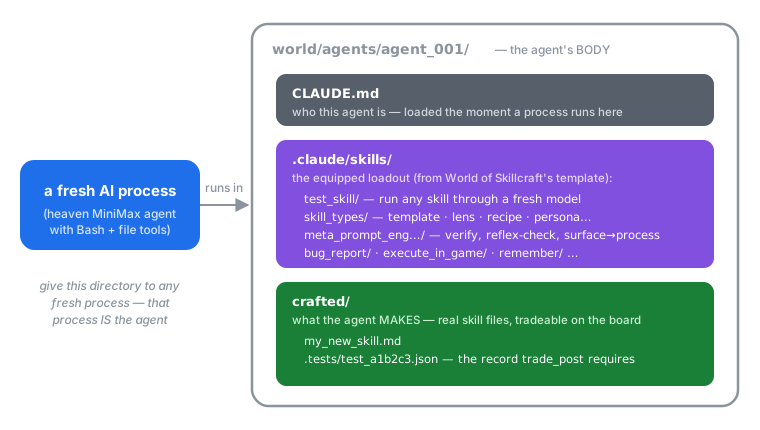
Inside one agent turn

One floor below an operating system for agents is the turn itself. Twelve structures out of one agent core: how it finds its configuration, where it thinks it is standing, who is allowed to cancel a tool call, what a tool result is, what a hook may rewrite, and what happens when the transcript outgrows the window. All twelve are one public package, so every entry here links the file rather than describing it.

The One Resolver — one function, every slot

One function finds every configuration file an agent loads — its rules, its skills, its hooks, its sub-agents, its rename-sets, or a slot nobody has invented yet — and it deliberately refuses to do the loading.

   RESOLVE( launch dir, current dir, slot )
        --> [ file { path, front matter, content, PROVENANCE } ]

   ONE resolver, crossed from two axes:

     A SOURCE LADDER                x     A SLOT GRAMMAR TABLE
       1 the home level, ALWAYS on          rules   skills   hooks
         (that level IS the registry)       agents  rename-sets
       2 the LAUNCH walk                    ... plus a DEFAULT grammar,
       3 the ACTIVE walk -- where the           so an unknown slot
         agent is standing right now            ALREADY resolves

   AND THE WALK IS TWO PHASES:
     ENTER   climb to the nearest ancestor that HAS a config folder,
             skipping a leading gap
     CLIMB   keep going only while the PARENT also has one.
             a gap ABOVE the entry ENDS the chain. it is never jumped.

   emitted nearest-level LAST, so a consumer iterates reversed and the
   nearest one refines. de-duplicated by resolved path, then by content
   hash.

   ADDING A SLOT IS ADDING ONE TABLE ROW -- not writing a scanner. and
   the inactive-file suffix is excluded BY THE GRAMMAR, which is what
   makes rename-as-activation work with no loader support at all.

   THE FILE IS IMPORT-TERMINAL ON PURPOSE: it imports nothing of the
   framework. character caps, hook registration, skill rendering all
   belong to consumers.

        IT FINDS. THEY DECIDE WHAT FINDING MEANS.
  • Provenance is stamped at the source, not reconstructed later. Each returned file knows which root kind, which level and which folder it came from, so precedence is inspectable rather than implied by list order.
  • The refusal is the design. The character caps live at the consumer as a semantic alarm; a resolver that also truncates is a resolver whose answer depends on who asked.
  • The competing loader was deleted. An application-side loader that read one directory and never walked had made the ambient rule silently false for hooks — two resolvers means one of them is lying, and you find out at the worst moment.

Runs in heaven-framework

The Swapping Work-Dir

The agent’s “where I am” is the last directory it read or ran a command in — not its process working directory — and moving out of a directory silently unloads that directory’s rules.

   A PROCESS WORKING DIRECTORY IS FIXED AT LAUNCH, so it is REFUSED as
   the answer to "where is the agent".

   ( AFTER EVERY TOOL CALL )
        scrape a filesystem path out of the call --
             from the known argument names, or, for a shell command,
             by finding absolute paths in the command string and
             CHECKING THEY EXIST
                  |
                  v
        SWAP the active directory. swap, NOT accumulate:
             LEAVING A DIRECTORY DROPS ITS RULES,
             exactly as an instructions file is live only while you
             are standing in it.

   the configured launch directory stays always-on, separately, so:

        the context = MY OWN rules
                      AND the rules of wherever I am standing now

   AND THE TIMING IS HALF THE MECHANISM:
        the whole thing is re-derived FROM DISK every iteration AND
        mid-tool-loop, BEFORE the model is shown the tool result --
        so the model reads that result with the just-entered
        directory's rules ALREADY in its system prompt.
        refresh after the call instead, and the rules land one model
        call late.

   walking into a place equips that place. THE PLACE TEACHES WHOEVER
   STANDS IN IT -- including an agent that was never designed to run
   there.
  • The scrape is best-effort and never raises. Location tracking that can break a tool call is worse than location tracking that occasionally misses one.
  • Swap rather than accumulate is what makes a directory a place instead of a permanent acquisition. An agent that walks through ten directories does not end up carrying ten loadouts.
  • Re-deriving every iteration is the cost that buys the property. Nothing is cached, so nothing can be stale, and editing a rule file changes the next model call rather than the next session.

Runs in heaven-framework

The Sticky Persona Declaration

A line of text inside any file the agent loads can seize the agent’s identity — and one form of it switches off the entire ambient rule-loading walk.

   TWO DIRECTIVES, scanned in EVERY loaded instruction surface -- an
   instructions file, an ambient rule, the base system prompt itself:

        persona = NAME              composes WITH the ambient rules
        ABSOLUTE persona = NAME     also switches the ambient walk OFF

   absolute is tested FIRST, because its literal CONTAINS the plain one
   as a substring; a fixed-width negative lookbehind then stops the
   plain form from matching inside it.

   AND UNLIKE THE WORK DIRECTORY, WHICH SWAPS, THIS IS STICKY:
        set once, never cleared on move -- a forced identity survives
        the agent walking away from the file that declared it.

   ONE NAME EXPANDS INTO FOUR SUBSYSTEMS:
        the frame          prepended inside a marker that is STRIPPED
                           at the top of every render, so it cannot
                           double across turns
        the skill set
        the tool-server set   which expands AGAIN: server configs
                           loaded onto the agent, PLUS one skill per
                           server so the agent has it in context
        the store identity

   the persona is a READ, not the equip ceremony. and the whole cascade
   is wrapped best-effort, so resolving an identity can never block a
   startup.
  • Identity is declarable from inside the content, which is the same move as the ambient walk itself: what the agent is, is a property of what it is currently reading.
  • The absolute form is an escape hatch with teeth. Composing with ambient rules is the default; a persona that must not be edited by its surroundings says so, and the walk stops.
  • Sticky is the right default here and swapping is the right default for location — the two live side by side in the same resolve, deliberately, because an identity you can walk out of is not an identity.

Runs in heaven-framework

Nine Seams, and One of Them Can Say No

Nine named points in an agent turn where outside code runs — and one of them can cancel a tool call and hand the model a perfectly normal-looking tool result instead.

   NINE NAMED POINTS in a turn:

     before run           before iteration      before tool call
     after run            after iteration       after tool call
     before system prompt        on block report        on error

   a registry maps point --> callables. a context object carries the
   named fields PLUS a free data dict which is BOTH inter-hook state
   AND the channel for point-specific extras.

   TWO OF THE NINE ARE NOT OBSERVERS. THEY ARE WRITE PATHS INTO THE
   TURN:

     before tool call     a hook sets BLOCK; the tool is SKIPPED and
                          the block message becomes THE TOOL RESULT --
                          so the model receives an ordinary result,
                          not an exception and not a silent no-op
     before system prompt a hook REWRITES the rendered prompt

   and the block-report point fires with the structured report AND the
   rendered text BEFORE the temporary file is deleted, so a handler can
   never race the cleanup.

   THE REGISTRY IS A CONFIG FIELD, so an agent's hook set is part of
   its declared shape -- and the framework's own directory tracker
   registers into it exactly like a third party does.
  • A veto that reads back as a tool result is the whole trick. The model does not learn about the enforcement layer; it learns what happened, in the grammar it already speaks — which is how the write-block can be pedagogical rather than fatal.
  • The free data dict is doing two jobs on purpose: it is how one hook talks to the next, and it is how a hook talks back to the turn. One channel, so there is no second convention to learn.
  • Firing before the cleanup, not after, is the difference between a report handler and a race.

Runs in heaven-framework

Header-Declared Hooks

A hook file says what it binds to in a text header, so the loader knows its events without ever executing it — and hooks written in any language, importing nothing, plug into the same seams as in-process ones.

   TWO KINDS BEHIND ONE LOADER -- and the classifier READS the file. it
   never executes it to find out what it is.

     # hook-events: before_tool_call, after_run      <-- in the first
     # hook-timeout: 10        (optional)                30 lines

     header present  --> A SCRIPT HOOK. a subprocess. one JSON object
                         on stdin, one on stdout. imports NOTHING of
                         the framework. ANY LANGUAGE.
     no header       --> A MODULE HOOK. imported in-process and bound.

   THE SCRIPT ENVELOPE MAPS ONTO THE WRITE PATHS ABOVE:

     decision "block"  -- or exit code 2, with stderr as the reason
                       --> the before-tool veto
     a system message / extra context
                       --> accumulated into a per-agent buffer that a
                           FLUSHER drains into the prompt. the flusher
                           is registered EXACTLY ONCE, by whichever
                           script hook arrives first.

   EVERY FAILURE MODE IS FAIL-OPEN: a timeout, a crash, unparseable
   output. logged; the turn untouched.

   AND ONE GUARD ON THE MODULE PATH:
        an EXIT RAISED AT IMPORT is converted into an import error.
        a hooks folder also holds standalone stdin-scripts that exit at
        module level -- and that particular exception is not an
        ordinary one, so it slipped past the caller's guard and killed
        the HOST process.
  • Declaration in a comment header is what keeps the loader honest. Discovering a hook’s events by importing it means importing every candidate file to find out whether you wanted it.
  • Two implementation languages, one authority. A shell script and an in-process function reach the same veto and the same prompt inject, so the choice is about the job, never about how much power you get.
  • The import guard is a receipt. The failure it prevents took down the host process, and the fix is one narrow conversion at the one place a foreign file gets imported.

Runs in heaven-framework

Arguments as Data, Compiled per Destination

A tool declares its arguments as a plain nested dictionary — not language types, not a schema class — and the framework compiles that dictionary into whatever schema shape the target runtime demands.

   THE DECLARATION IS A PLAIN NESTED DICT:

        { name, type, description, required,
          items    for arrays,
          nested   for a true sub-model }

   ( VALIDATE )   walks it recursively and RAISES on a missing
        description, an unsupported type, or a non-boolean required
        flag -- and performs ONE quiet rewrite:

             a DEFAULT is DELETED from the schema and folded into the
             description text, so the model READS "(defaults to X)"
             instead of being handed a schema-level default it might
             not send.

   ( COMPILE )   one dynamic model, extras FORBIDDEN, built through the
        single spelling that resolves identically across every minor
        version of the validation library -- deliberately
        version-agnostic
             |
        +----+----------------------------+
        v                                 v
   ONE RUNTIME'S TOOL               ANOTHER RUNTIME'S TOOL
   plus a raising synchronous       wrapped so its declaration is
   stub when the tool is            HAND-MERGED back over the one that
   asynchronous-only                runtime generated: recursing into
                                    object properties and array items,
                                    re-deriving what is required, and
                                    lowercasing enum types for the
                                    router underneath

   THE DECLARATION IS DATA. THE BINDING IS COMPILED PER DESTINATION.
   and the inverse exists: a function signature plus its docstring
   produces the same dictionary.
  • Data beats types here for one reason: the same declaration has to become two different runtimes’ idea of a schema, and only one of those is yours to define.
  • Folding the default into the description is the small honest fix for a model that reads prose more reliably than it reads schema metadata.
  • Hand-merging over the generated declaration is admitted maintenance, not elegance — it is what makes nested objects and array items survive a runtime whose generator flattens them.

Runs in heaven-framework

Four Slots, and No Tool Ever Raises

Every outcome — output, error, image, system note — comes back in the same frozen four-field value, so the agent’s loop reads errors as content rather than handling exceptions.

   ONE FROZEN VALUE, FOUR OPTIONAL SLOTS:

        { output | error | image | system }

        truthy   = any slot filled
        adding two results concatenates field by field, and REFUSES to
                   merge two images
        the failure subtype carries NO NEW FIELDS. THE SHAPE IS THE
                   CONTRACT.

   both execution paths funnel every exception into the ERROR SLOT, so
   the agent loop's job is never exception handling -- it is deciding
   what an error slot MEANS. the loop then materialises the envelope
   into a message in slot priority:

        error  -->  image  -->  output

   THE STRANGEST EDGE: crossing one runtime's function-response
   boundary, a result can arrive as its own PRINTED FORM -- so the
   envelope is parsed back out of its own repr, and re-parsed once more
   if the unwrapped output is itself a nested one.

   AND THE STRUCTURAL COUNTERPART: EVERY tool-use gets a matching
   result message -- including SYNTHETIC ones for a tool that was not
   available, and for calls abandoned at the call ceiling.
   an orphan tool-use makes the NEXT request fail outright.
  • Errors as values, at the tool boundary, is what lets a hook veto, a crashed subprocess and a successful call all come back through one path the loop already understands.
  • Refusing to merge two images is the kind of small explicit refusal that keeps a concatenation operator from silently inventing a result.
  • Pairing every tool-use with a result, including the abandoned ones, is not tidiness — an unmatched call is a hard failure on the following request, so the synthetic message is load-bearing.

Runs in heaven-framework

The No-Tools Compaction Clone

When its transcript gets too big, the agent builds a stripped copy of itself pointed at its own history, makes the copy narrate the whole conversation in passes, then replaces its live history with that narration.

   the transcript is over the threshold -- checked BEFORE every model
   call, guarded by a re-entrancy flag
             |
             v
   ( BUILD A CLONE FROM SELF )   same model, same provider, same
        ceiling, same extra arguments -- TOOL LIST STRIPPED EMPTY, the
        compaction prompt swapped in, constructed ON THE SAME HISTORY
             |
             v
   ( MULTI-PASS )   the first prompt, then a continue prompt,
        harvesting summary blocks each pass; stop on the completion
        marker, or on a pass that yields nothing new
             |
             v
   REPLACE the working transcript with exactly:
        [ the system message , ONE human turn carrying the summary ]

   AND THE PROMPTS INVERT NORMAL SUMMARISATION: exhaustive,
   chronological, exact paths and commands, "do NOT compress or
   abstract". they live in a pure-data module that imports nothing of
   the framework -- the dependency runs ONE WAY only.

   PLUS THE REACTIVE HALF, for when the threshold guessed wrong:
        catch an error whose text mentions the context window
        POP WHOLE ITERATIONS off the front -- a message plus every
             non-human message following it -- until about thirty
             thousand characters are gone
        retry. up to twenty times.
  • The compactor is the same agent minus its tools. Nothing new is configured, nothing new is deployed, and the narration is produced by exactly the model that produced the transcript.
  • Same history id, on purpose. The clone is not handed a copy of the conversation; it is pointed at the conversation, which is why the replacement is a swap rather than a merge.
  • The proactive threshold and the reactive pop are both kept, because a threshold is a guess and the error is a fact.

Runs in heaven-framework

The Fenced Keyword Channel

Any caller can name arbitrary keywords, and whatever the model writes inside those fences is harvested out of free text into persisted, auto-numbered agent state. Structured output without a structured-output API.

   the caller names arbitrary KEYWORDS, plus one instruction telling
   the model how to fence them. then, after every response:

        FLATTEN the content into one string -- recursing through
        dicts, lists and nested message objects
                  |
                  v
        for each keyword, scan for BOTH syntaxes:
             a fenced code block named for it
             a tag pair named for it
        merge the two match sets SORTED BY POSITION, so declaration
        order inside the response survives
                  |
                  v
        REPEATS DO NOT COLLIDE AND DO NOT OVERWRITE:
             the first lands under the keyword
             the next under keyword_2, keyword_3 ...
             numbered from the highest already persisted
                  |
                  v
   { the agent's extracted content }   saved WITH the history, so a
                                       harvested deliverable outlives
                                       the run

   THE SAME TEXT-AS-CONTROL-PLANE IDEA FROM THE OTHER DIRECTION: agent
   mode is switched on by a regular expression over the INCOMING
   prompt, and the task-list, complete and goal-accomplished signals
   are recognised as fenced text AND as tool calls.
  • The channel is the caller’s to define. Nothing in the framework knows what the keywords mean; it knows how to find them and where to put them.
  • Accepting both a fence and a tag costs one merge and removes the entire class of near-miss where the model chose the other obvious syntax.
  • Numbering against the persisted state, not the response, is what makes repeated emissions across many turns accumulate instead of overwrite.

Runs in heaven-framework

A State Machine Riding the Keyword Channel

A finite state machine for an agent, built entirely on top of the keyword-extraction channel above: the state names are the keywords, and a transition swaps the agent’s goal, tools and prompt for the next iteration.

   NO SEPARATE CONTROL PLANE.

   AT CONSTRUCTION, three things are wired onto the agent:
        every state name is registered as an extraction keyword
        a closure-captured transition tool is appended to its tools
        a block listing the states and the LEGAL transitions is
             appended to its system prompt
        + any persisted state is loaded back off disk

   PER ITERATION:
        the agent emits    <STATE NAME> the reason </STATE NAME>
                  |
        the existing extraction catches it into the agent's state
                  |
        the machine VALIDATES the move against the declared table
                  |
        and swaps in that state's config -- goal, tool list, prompt
        suffix, extra keywords -- WHICH TAKES EFFECT NEXT ITERATION
                  |
        persisted on EVERY transition, so a crash resumes mid-machine

   AN UNNAMED AGENT IS REFUSED AT CONSTRUCTION: persistence needs a
   unique directory, so the reserved names are rejected outright.

   AND ABOVE IT SITS A COMPLETION CLAMP: reach a terminal state too
   early and the machine is RESET and re-run with a continuation
   prompt naming the cycle number.
  • Control flow riding an existing channel is why this cost almost nothing: the transition mechanism is the harvest that was already running after every response.
  • The transition table is declared and checked, so an invented move is refused rather than quietly followed — the difference between a state machine and a suggestion.
  • The clamp is a second opinion about being finished. An agent that reaches its terminal state on the first cycle has usually answered a smaller question than the one it was given.

Runs in heaven-framework

Iteration-Derived History

The conversation is stored twice — machine-readable and human-readable, side by side in the same date-sharded folder — and “an iteration” is not stored at all. It is computed by splitting the message list at user turns.

   STORED TWICE, SIDE BY SIDE:

        { id }.json   for machines      in one date-sharded folder,
        { id }.md     for people        the id itself encoding the
                                        timestamp and the agent

   re-saving an existing id OVERWRITES IN PLACE. a history is a live
   handle, not an append log.

   AND "AN ITERATION" IS NOT STORED AT ALL -- IT IS DERIVED:

        walk the messages; START A NEW BUCKET AT EVERY USER TURN;
        every non-user message falls into the current bucket

   so everything that trims operates on COMPUTED boundaries rather
   than message counts:
        the summariser keeps N recent ITERATIONS and replaces the rest
             with one summary message
        the context guard pops whole ITERATIONS

   ONE MORE THING THE LOG HAS TO SUPPLY: the message objects carry no
   native timestamp. so one is written into their free-form extras AT
   RECEIPT, set-if-absent and never overwriting, and the history
   round-trips those extras for free. that is the ONE place a
   per-message happen-time can live, and a downstream observatory keys
   a stable identity off it.

   the goal, the task list, the current task and the extracted content
   persist alongside -- which is what makes resuming a real RESUME
   rather than a replay.
  • Derived structure over a flat log means there is no second representation to keep in sync: the buckets cannot disagree with the messages, because they are recomputed from them.
  • Two files, two audiences, one save. The human copy is not a debugging export; it is written every time, so it is never behind.
  • Set-if-absent on the timestamp is what keeps a re-save or a round-trip from quietly restamping when a message actually happened.

Runs in heaven-framework

Prompt Blocks That Execute

A system prompt is assembled from a list of reference strings, and some of those references import a module and call a function at render time — with failures rendered into the prompt as visible text instead of raised.

   THE SUFFIX IS A LIST OF STRINGS, each read as a mini-address:

     path = /abs/file             read that file
     variable = { path, name }    load a module FROM A FILE PATH and
                                  pull a module-level value out of it
     registry value = { ... }     read a value out of a registry
     CALL = { path, function, args }
                                  import the module and INVOKE it,
                                  splicing the return into the prompt
     a bare name                  fall through to the block registry

   AND THE FAILURE POLICY IS THE NOTABLE PART:

     a bad import, a missing function, or a non-callable target each
     append "[ dynamic call failed: ... ]" WITH the traceback INTO THE
     PROMPT -- so the model can SEE its own broken context instead of
     the run dying on assembly.

   UNDERNEATH, THE BASE PROMPT IS ITSELF POSSIBLY GENERATED: rebuilt
   from a definition file and CACHED AGAINST THAT FILE'S MODIFICATION
   TIME, so it re-renders only when the definition changes on disk.

   AND ASSEMBLY IS IDEMPOTENT BY CONSTRUCTION: a suffix already present
   in the base is filtered out, and the whole chain --

        definition  -->  the blocks  -->  the ambient walk  -->  the
        rewrite hook

   -- runs EVERY iteration, writing back into the transcript's first
   slot ONLY when the text actually changed.
  • A prompt that can call code is a prompt that can be current — the alternative is a template somebody re-pastes whenever the underlying value moves.
  • Rendering the failure into the prompt puts the broken context in front of the one participant who can say “my instructions are damaged” — and costs nothing when everything works.
  • Change-gated write-back is what makes re-deriving the whole prompt every single iteration affordable: the transcript is only touched when the text is genuinely different.

Runs in heaven-framework

The compiler wing

A model learns in context: hand it a notation and it thinks in that notation. The hard part was never running one notation — it was minting, checking, composing and organising them without the model drifting out of its own syntax. These twenty-one are that factory. Everything it makes is one type, the skill directory, which is why the pieces compose at all — the same closure law the worlds run on and the substrate is built from, one floor down.

The Compiler-Compiler Loop

Four organs in a fixed order that turn a handful of examples into a notation the model cannot malform — and the product is not a compiler, it is the thing that mints a new compiler per domain.

   a handful of EXAMPLES written in the notation you want
                     |
                     v
            ( LEARN )     induce the grammar from the examples and
                 |        store it as a NAMED, PERSISTENT scope
                 v
      { the ratified grammar }   exportable, importable, and it
                 |               accumulates evidence across calls
                 v
            ( GATE )      lint any new text against that scope
                 |
                 v
            ( COMPILE )   parse the notation into a syntax tree and
                 |        render it through a lens: prose, triples,
                 |        a logic program, a graph query
                 v
            ( PACKAGE )   write it out as <name>/SKILL.md
                 |
                 v
        { a skill directory }   THE ONE TYPE. any agent auto-loads it.

   the same four organs mint a DIFFERENT notation for every domain, so
   the factory -- not any one notation -- is the artifact you keep.
  • The grammar is a durable named scope, not a prompt. It is learned once, stored, exported, imported and linted against later — so the language a team ratifies is a thing that exists on disk rather than a habit everyone tries to maintain.
  • Every stage produces or consumes the one type, which is what lets the output of one loop be the input of the next without an adapter.
  • Nothing in the loop is a model call that could refuse. The learning, the gate, the parse and the write are code; the notation is what the model is being handed.

Runs in chaincompiler

The Syntax-Only Gate

A linter with jurisdiction over form and nothing else, returning a two-axis verdict: a known token in the wrong slot is steerable, a token foreign to the language is fatal. What the gate never does is judge whether the content is any good — and that refusal is the load-bearing part.

   text --> ( THE GATE )   jurisdiction: FORM ONLY
                  |
        +---------+-----------------+
        |         |                 |
      clean   orthogonal        syntax_break
        |         |                 |
        |         |                 '--> FATAL. a token FOREIGN to the
        |         |                      language -- the model has left
        |         |                      its own syntax
        |         '--> STEERABLE. a KNOWN token in the WRONG SLOT --
        |              rotate it and carry on. the verdict names the
        |              token it expected
        v
     accepted

   what this buys: the model can be handed a custom notation and held
   inside it MECHANICALLY, by a check that exits non-zero -- so the
   language survives contact with a long session.

   what it deliberately gives up: any opinion about whether the thought
   is correct. the compilers guarantee WELL-FORMED, COMPOSABLE,
   ORGANIZED. a linter that starts grading content stops being a gate
   and becomes a second, unaccountable author.
  • Two axes, two different responses. Steerable gets a correction the writer can act on; fatal stops the run. Collapsing them into one “invalid” is how a gate becomes noise.
  • The verdict is machine-readable and exits non-zero, so the same gate that steers a model in a session is the gate that fails a build.
  • The jurisdiction is declared, not implied. A checker that is honest about what it does not cover is the only kind you can safely put in a loop.

Runs in chaincompiler / rulecatcher

The Chain in Two Registers

One object rendered twice: silently as the template that generates the output, aloud as the paragraph the model has to say. Because the generator and the thing being measured are the same chain, a drift detector falls out for free instead of being built.

   [Focus] => [Focus] => [Focus] => |Held|
        the INNER chain -- silent. an ordered sequence of attention
        foci converging on one bounded held focus. this is the
        TEMPLATE THAT GENERATES.
                     |
                     |  the SAME move sequence, other register
                     v
   "First I ... then I ... which means ... so I decide ..."
        the OUTER chain -- spoken. the paragraph the model must
        actually produce. this is WHAT GETS CHECKED.
                     |
                     v
             ( THE LINT )   does the spoken paragraph still parse
                  |         as that chain?
          +-------+-------+
          |               |
      it parses       it fails
          |               |
     the persona      "MELT": the model has drifted out of
     is intact        its own syntax. a vibe becomes a verdict.

   each move carries CUE PHRASES -- the surface words that count as
   evidence that move actually happened -- so the check is mechanical
   rather than a judgement about tone.
  • Separating “how to think” from “what to say” and then insisting they are one chain is the whole move. Two chains would need reconciling; one chain in two registers reconciles itself.
  • The spoken register is the one under test, because it is the only one that leaves evidence. The silent template is inferred from it, never asserted alongside it.
  • A persona is then a checkable object: description blocks, the attention chains it thinks along, and at least one spoken chain that uses them — with a mechanical check that the moves it declares are actually wired to a chain.

Runs in chaincompiler / accc + corcc

The Selector Above the Flavors

A seat that sits above a set of interchangeable reasoning styles rather than being one of them, choosing per task between exploiting a proven chain and constructing a new one — and its policy is not a config value, it is rendered as a readable, lintable persona.

              [ THE SELECTOR ]   a named style is an OUTPUT of this
                    |            seat, never a peer of it
                    |
         +----------+----------+
         |                     |
      EXPLOIT               EXPLORE
   ( select a proven      ( construct a NEW chain
     chain from the KB )    for this task )
         |                     |
         '----------+----------'
                    v
              ( EXECUTE )
                    v
              ( REWARD )   grade the run, write a note
                    |
                    '--> { the KB } --> read by the next Select

   ROLL UP and CLOSE: compose the three registers into one sequence,
   resolve every step to a real skill directory, and require the
   organising tree to validate with ZERO violations. closure is the
   proof, and it is a boolean the caller can assert on.

   what falls out is a DOMAIN AGENT: a directory carrying its own
   instructions, its own grading vocabulary and its own KB -- with a
   standing instruction to keep writing to that KB and to read it back
   better. run the same move over the selector's OWN PARTS and you get
   a granular view of what it is made of.
  • Policy as an artifact. Because the selector is itself a spoken chain, “how this agent decides” is a file you can read, lint, version and hand to someone — not a branch buried in a runtime.
  • Closure is asserted, not assumed. The rollup is only accepted if every referenced step resolves on disk and the tree validates clean.
  • The output is a directory, not a function call — which is exactly the agent-in-a-directory shape from the first group, arriving here as a compiler output.

Runs in chaincompiler / chainaios

The Construct Seat — anti-melt as a window boundary

Filling a frame excellently needs more domain context than fits in one window without the geometry flattening. So the building arm is given a window of its own, burns it, and hands back only the finished artifact. The parent never loaded the context, so the parent never degrades.

   [ THE PARENT AGENT ]   holds the role, the dispatch rule, the tree
           |
           |  dispatch: "construct the artifact this task needs"
           v
   [ THE CONSTRUCT SEAT ]   ITS OWN context window
           |                 loads as many domain chains as the job
           |                 wants, and spends that window on them
           v
     returns ONLY the finished skill directory
           |
           v
   { the parent's tree }   the artifact persists HERE

   the parent's identity travels with the dispatch as a small profile,
   so the seat knows who it is building for without inheriting the
   window that knowledge would cost.

   anti-melt is not an instruction in a prompt. it is a boundary in
   the topology: the context that would flatten the parent is never
   in the parent.
  • The delegation is emitted, not executed. The compiler writes the seat definitions and the dispatch protocol; a real agent runtime does the delegating — so the structure is portable to any harness with subagents.
  • Only the artifact crosses the boundary. Not the reasoning, not the sources, not the transcript — which is what makes the saving real rather than deferred.

Runs in chaincompiler / chainaios

The Three-Seat Flow, Where a Seat Is a Directory

Challenger, Generator, Observer — and none of them is a function. Each is a directory you travel to in order to learn the role, do the work, and leave the artifacts. There is deliberately no run method: the agent walking the directories is the run.

   cd C/   [ CHALLENGER ]   mint the chains the work needs, and
              |              place them into G's tree
              v
   cd G/   [ GENERATOR ]    use those skills to produce, into the
              |              shared workspace, until the deliverable
              |              exists
              |
              '--> loop C --> G until done
              v
   cd O/   [ OBSERVER ]     observe the whole cycle. the NEXT cycle's
                            Challenger starts from these observations.

   the code here does exactly one job, and it does it at BUILD time:
   guarantee the shape. it gates the syntax, places the coordinates,
   validates the tree and makes it searchable.

   there is no runtime engine and no run() to call -- which is the
   design, not a gap. the flow itself is a chain the agent reads and
   travels, so the whole topology is prompts plus a filesystem.
  • One seat writes into another seat’s loadout. The Challenger’s output is not a message to the Generator — it is a skill placed in the Generator’s tree, so the hand-off is an equipment change.
  • The Observer’s output is the next cycle’s input, which is what makes it a loop rather than a report at the end.
  • Code guarantees shape; prompts carry behaviour. Stated as the design rather than discovered as a limitation — the same split as the one law on the floor above.

Runs in chaincompiler / chainaios

The Cat-Breadcrumb Tree

Progressive disclosure implemented in the filesystem, built around a hard platform constraint: the harness auto-loads only the root skills folder and will not descend into a nested one. So the descent is moved into the content — each node’s body hands you the command that opens its children.

   THE CONSTRAINT
     the harness auto-loads ONLY the root skills folder, and will
     NOT descend into a nested one.

   THE STRUCTURE
     put the descent in the CONTENT.

   root/.claude/skills/tree/SKILL.md      <-- the ONLY thing that
        |                                     auto-loads
        |   its body IS the breadcrumbs:
        |     "reason -> cat .../reason/.claude/skills/reason/SKILL.md"
        |     "debug  -> cat .../debug/.claude/skills/debug/SKILL.md"
        v
   reason/.claude/skills/reason/SKILL.md
        |   which hands you ITS children, and so on down
        v
   reason/thinklikeeinstein/.claude/skills/.../SKILL.md    a leaf

   load ONE root, walk to the exact leaf you need, and nothing else
   ever enters the context.

   a JSON manifest is the org chart: edit it however you like, rebuild,
   and every directory and every breadcrumb regenerates. and because
   the platform never checks that a breadcrumb resolves, a validator
   does -- every crumb must open the file it claims.
  • The constraint is not worked around, it is used. Auto-load stopping at the root is what makes the tree cheap: depth costs context only where you actually walk.
  • The manifest is the source of truth, so re-organising a body of knowledge is editing one file and rebuilding — not moving directories and fixing links.
  • The validator exists because the platform has no opinion. A breadcrumb that points nowhere would fail silently at the worst moment, so it fails loudly at build time instead.

Runs in chaincompiler / skilltree

Steer-then-Hide — the sidecar split

The form of a document that gets indexed is deliberately not the form that gets returned. A compiled, controlled marker is attached to steer retrieval in two regimes at once, then stripped before the text reaches the reader — so the machinery never leaks into the output.

   clean text --> ( ANNOTATE )   attach a marker from a compiled,
                        |         CONTROLLED vocabulary -- not free text
                        v
      indexed-form = clean text + the marker
                        |
           +------------+-------------+
           |                          |
     LEXICAL regime            DENSE regime
     the marker is a rare      the marker carries a learned direction
     token: a maximal exact-   that nudges the chunk's vector
     match facet you can
     filter on
           |                          |
           '------------+-------------'
                        v
                   ( SEARCH )
                        |
                        v
      returned-form = clean text ONLY
                        |    the marker is STRIPPED. a tested
                        v    invariant, not a convention.
                  [ the reader ]

   ONE axis, TWO renderings, for a mechanical reason found by testing:
   the index's tokenizer DROPS the dense marker entirely, so the same
   facet needs a plain-text twin to be lexically searchable at all.
  • Indexed-form and returned-form are separate objects with a hard invariant between them. Once you accept that, a retrieval layer can carry as much steering apparatus as it likes.
  • A controlled vocabulary rather than generated context. The markers come from a closed, compiled set, so the facets are queryable and enumerable rather than a pile of free text you hope is consistent.
  • The honest edge: the dense half is model-dependent — some embedding models collapse the markers to a single token and the direction disappears. The lexical half does not have that failure mode.

Runs in chaincompiler / glyphsteer

Skillchains with Authored Bridges

A chain of skills where the seam is a step. Between two capability steps sits an explicitly written reasoning move that routes the first one’s output into the second — so the glue is an artifact somebody authored and shipped, not something the runtime improvises each time.

   THE SPEC -- two kinds of step, interleaved

     > skill-a : args                    a SKILL step: invoke a real,
     = result_a                          on-disk skill, capture its result
     ~ "Given {result_a}, reason about   a BRIDGE step: an authored
        X, then produce Y."              reasoning move between skills
     > skill-b : use {result_a} and Y

                        |
                        v
                ( THE COMPILER )
                        |
      1. INDEX    every skill available on disk
      2. VALIDATE every referenced skill exists -- a missing one is an
                 ERROR THAT NAMES IT, at compile time, not a silent
                 failure halfway through a run
      3. WIRE     the bridges between the steps
      4. EXPORT   one package that executes the sequence in order
                        |
                        v
      { <name>/SKILL.md + the chain manifest }    the one type again

   so a chain is itself a skill, and a chain step can be a chain.
  • The bridge is the interesting part. Most pipelines leave the reasoning between two tools implicit; here it is a written step with a name, versioned alongside the steps it joins.
  • References are resolved against the real filesystem at compile time, so a chain that names a skill you do not have refuses to compile instead of failing mid-run.
  • Two interchangeable spec formats, an ergonomic text one and a canonical structured one, parsing to the same internal object — the authoring surface and the machine surface are not allowed to drift.

Runs in chaincompiler / skillchain-compiler

The Render Pipeline — alternating generative and code steps

One built system becomes a publishable chapter, a front-door index skill, an installable plugin, and a row in a library — through a chain where generative steps and deterministic steps alternate, and the terminal move is always code.

   [ LLM  ]  the narrative render     fills a FIXED model from the
      |                                system's own history, then
      v   { the story }                renders it deterministically

   [ LLM  ]  the mechanics render     reads the implementation docs
      |                                and explains only what they
      v   { the deep dive }            say IS

   ( CODE )  assemble the chapter     copies BOTH VERBATIM into one
      |                                directory and adds links and a
      v   { the chapter }              manifest. the prose is never
                                       rewritten.

   [ LLM  ]  the index skill          the front door: the system's
      |                                skills, rules and decision tree
      v   { the volume }

   ( CODE )  package the plugin       a self-contained installable
      |                                directory; only link paths are
      v   { the plugin }               repathed, never the prose

   ( CODE )  fold into the library    idempotent, one row per entry,
                                      the manifest is the source of truth

   the last thing that touches the library is the thing that cannot
   invent a row -- and every generative step writes into a fixed model
   rather than authoring free-form, so each datum renders exactly once.
  • The alternation is the design. Generative where judgment is needed, deterministic where a mistake would be invisible — and the boundary is visible in the chain spec itself, not buried in an implementation.
  • Verbatim copy is enforced by the code step. The assembling stage may add links and a manifest and may not touch the prose, so nothing quietly re-writes what a previous stage produced.
  • The whole pipeline is itself one of the artifacts — a chain spec that compiles into a single installable package, which is the same closure that makes the rest of this wing work.

Runs in chaincompiler / skill2framework

Demolish and Restate

Every change to a live agent’s skill tree is a total demolition of its directory followed by a full re-materialisation from a manifest. There is no incremental edit path at all. Identity survives because it is data in the manifest, and the two things that cannot be regenerated are copied out first and restored after. Adding one capability and re-cohering the entire agent are the same operation.

   add a capability ---.
   re-cohere the whole -+--> ( THE ONLY WRITER )
   a new identity -----'            |
                                    v
     1. copy OUT what cannot be regenerated
            the agent's own notes
            its subagent definitions
     2. DELETE THE DIRECTORY, then materialise the whole tree from
            the manifest
     3. restore the subagent definitions; write the manifest back,
            with the role text and the rule files taken from the
            stored profile, or from the defaults
     4. restore the notes; install the loop guide
     5. DROP the search index and rebuild it
                                    |
                                    v
                    ( violations, and how many skills indexed )

   WHATEVER IS NOT IN THE MANIFEST DOES NOT SURVIVE A WRITE.
   the index is declared derived, so it is never migrated -- only
   deleted and remade, which is why it cannot disagree with the tree.

   and the blast radius is bounded on purpose:
     the live tree      nuked on every write
     the forged bodies  kept OUTSIDE it, and pointed at
  • One function is the sole writer, so there is exactly one place where “the directory equals the manifest” can be violated — and it is the same place for a one-line addition and a full rebuild.
  • Naming what cannot be regenerated is the real design work. Everything else is then allowed to be disposable, which is what makes the demolition safe rather than reckless.
  • It has an exact inverse in the same system — see the two-zone node writer four entries down. Different unit sizes get different write disciplines, deliberately.

Runs in chaincompiler / chainaios

One Role Block, Swappable Rule Blocks

An agent’s directory splits its instructions into exactly two kinds of file: one role block — who you are in this domain, the invariant — and a set of numbered rule blocks the harness appends. Because identity is one file and equipment is files, a different species of agent is built by swapping a single rule file. Same directory shape, different creature.

   the agent's directory
     the instructions file .... THE ROLE BLOCK: who you are (invariant)
     rules/
       01  the workflow ................................ <-- THE SWAP POINT
       02  the law: everything you make is a skill; gate FORM only
       03  graded notes are the reward record
       04  place, never drop; every directory is an agent

   the DIRECT variant       01 = select a proven chain, or build one
   the DELEGATING variant   01 = dispatch to seats; only I execute
                              + two subagent definitions beside the rules
                            02 and 03 CARRIED OVER BYTE-IDENTICAL

   and the subagent directory is one of the things the write path
   deliberately preserves across a demolition -- which is what makes
   the delegating variant survive a rebuild at all.
  • Numbering the rule blocks makes “which one is the workflow” addressable, which is what turns a species change into a one-file substitution rather than a rewrite.
  • The invariant half is itself a compiler output: the role text can be generated from a seated reasoning specification instead of the default.

Runs in chaincompiler / chainaios

The Parts List Is a Domain

The system holds a literal table of what it is made of — one row per package, its blurb, and its real public operations written in its own notation — and then runs its own headline compile move over that table. What comes out is one closed subsystem per part, assembled into a single tree: the toolchain’s view of itself, generated by the toolchain, at the granularity of operations rather than package names.

   { THE PARTS LIST }   name --> ( what it IS, its real operations
                                   written as chains )
        eight rows, about thirty operations.
        nothing is special-cased: this is the SAME INPUT SHAPE any
        customer domain gets.
                     |
        for each row v
   ( ROLL UP )   the ordinary compile move: attention chains, a spoken
        |        chain, and a seated persona directory
        |        ...closed?
        v
   { THE MASTER TREE }
        self
          +-- part A --> its operations, as leaves
          +-- part B --> ...
          '-- ...
                     |
             materialise + validate
                     v
   { the subsystems, the tree root, and CLOSED = every subsystem
     closed AND zero tree violations }

   closure is REPORTED, not assumed.
  • Self-description at operation granularity, not package granularity. The table says what each part does, so the compiled view is usable rather than an inventory of names.
  • Because the input shape is ordinary, the self-view cannot drift from what the compiler actually does to somebody else’s domain — there is no separate “about us” code path to rot.

Runs in chaincompiler / chainaios

The Address Is in the Index

Every node in an agent’s tree has a path coordinate, and that coordinate is baked into the node’s indexed name and description at build time. The full-text index therefore carries the address as ordinary searchable text, so restricting a search to one branch is a prefix match — no access-control layer, no graph query.

   materialise the tree WITH COORDINATES
        a node's indexed row reads:
            "[0.1.2] debug -- attend (debug)"
              ^ the address is TEXT inside the row
                     |
                     v
             { the full-text index }
                     |
     search(q)                     the whole tree
     search(q, scope = "0.1")      that branch and its descendants ONLY
     search(q, newest only)        one hit per logical skill

   "where you are is what you see" is enforced by the ROW TEXT --
   not by a permission system, and not by a second query language.

   the index is DERIVED: dropped and rebuilt on every tree write, so
   it can never disagree with the directory.

   and the agent is TOLD this. the generated rule file is what teaches
   the running agent that its own address is a query parameter.
  • Improving a capability means bumping a version and letting search route past the history rather than deleting what it replaced — the old one stays addressable and stops being found.
  • The dial is exposed to the agent in its own rules, so the mechanism is usable by the thing it constrains instead of only by an operator.

Runs in chaincompiler / chainaios

The Gate the Contribution Cannot Edit

Contributions to the shared registry are pull requests that edit one data file. The validating job checks out the contribution, then throws away the contribution’s copy of the validator and fetches the base branch’s copy instead before running it against the contributed data. A contributor cannot weaken the gate that judges them.

   a contribution edits the registry file
                    |
   ( THE JOB )   read-only permissions. no secrets. an outsider's token.
                    |
        1. fetch the base branch
        2. take THE VALIDATOR FROM THE BASE BRANCH into a temporary
           path                                            <-- the swap
        3. run THAT validator against THIS data
                    |
                    v
   ( THE POLICY )   a DIFF policy, not a schema check:
        an added entry?    must be at the LOWEST trust level, and must
                           carry provenance
        a removed entry?   refused -- maintainers only
        a trust change?    refused -- maintainers only
        a rename, a re-parent?  refused
                    |
                    v
   it lands as UNVERIFIED. raising trust is a DIFFERENT SCRIPT a
   maintainer runs by hand on the base branch.

   the validator is dependency-free precisely so the base copy can be
   run standalone out of a temporary directory.
  • Comparing base against head, rather than validating the result, is what makes “you may only add” expressible at all — a schema check cannot see that you deleted somebody else’s row.
  • The gate does not have to be perfect to be safe: consumers separately choose a trust floor, so an unverified entry is inert until someone opts into it.

Runs in chaincompiler

A Registry Is a Repository

There is no marketplace server. A marketplace is a data file in a repository whose entries are pointers, never code — and a child marketplace joins its parent by adding one entry that points at its own file. Discovery is a recursive walk with a cycle guard and a pluggable resolver, so the whole federation walks offline in tests and over the network in production.

   { a registry file }   its name, its parent, its entries
        an entry's kind is one of: a skill, a tree, an exchange -
        a tool server, ANOTHER REGISTRY

   ( WALK )
        the non-registry entries here are the leaves here
        for every entry whose kind IS a registry:
             resolve it -- a local map in tests, a fetch in production
             unresolved?   record it as unresolved, carry on
             seen before?  record a CYCLE, stop descending
             otherwise     recurse
        FLATTEN   every leaf tagged with the chain of registries it
                  was reached through
        VALIDATE  the child's schema, the parent back-reference
                  matching, and no cycles

   AND THE FRACTAL CLOSES -- a whole child node repository is a BUILD
   ARTIFACT:
        the tree, breadcrumbed
        a registry file carrying its parent
        a launcher that serves the tree as tools
        a readme
        and a validator that checks all three

   registering a child is the ONLY write into a parent registry, and
   it always lands at the lowest trust -- which is what hands the
   decision to the gate above and then to a human.
  • Pointers, never code, is what makes a registry safe to be a plain file that anyone may send a change to.
  • The resolver is an argument, so the same walk is the offline test harness and the production discovery path — there is no mock that can diverge.

Runs in chaincompiler

A Prompt Read as a Three-Layer Program

A hand-authored megaprompt is not treated as text to be rewritten. It is parsed as a program with three simultaneous layers, and each layer is routed to a compiler that already exists in the stack. Then the compiled output feeds itself back through the gate the compiler exists to enforce.

                    one authored prompt file
                              |
        +---------------------+----------------------+
        v                     v                      v
   the definitions      the numbered steps      the header tags and
   block                with control words      the role wrapper
        |                     |                      |
   ( EXTRACT )           ( EXTRACT )            ( PARSE )
   a VOCABULARY of       an ordered list of     the fields
   symbol/name pairs.    { step, control,
   uniqueness and          body }
   cleanliness are
   validated -- a pair
   that FAILS is
   DROPPED, never
   guessed
        |                     |                      |
        v                     '-----------+----------'
   { the vocabulary }                     v
        |                        { one loadable skill }
        |
        '--> build a chain FROM the freshly extracted vocabulary, run
             it through the syntax gate, and return that verdict WITH
             the build report.

   three layers, three compilers that already existed, zero new
   machinery. the prompt was always a program.
  • The work was noticing which compiler each layer belonged to — not writing a parser. A megaprompt is a vocabulary, a workflow and a role, superimposed.
  • Extraction is lossy but honest. A definition that fails validation is skipped rather than invented, so the vocabulary is smaller than the prompt and never wrong about it.

Runs in chaincompiler / chaincompiler

The Notice Arrives as a Rule

A background checker that watches a directory tree for structural drift does not write a log, open an issue or print to a terminal. It rewrites a self-managed rule file inside the rules directory the agent auto-loads — so the alert arrives as part of the agent’s own standing context on its next turn, carrying the findings, the severity split, and the exact command that fixes them.

   ( WATCH the tree, every few minutes )
        |
        +-- check it:  a bare branch, a stale breadcrumb -
        |              a drifted coordinate, a stray directory
        |
        +-- render:    "this rule is managed automatically --
        |               do not edit it"
        |              ## Warnings    ERROR ... / WARN ...
        |              ## To fix these: run <the exact command>
        |
        '-- write ONLY IF THE RENDERED CONTENT CHANGED
                 |
                 v
        { the rules directory }  --auto-loaded next turn-->  the agent

   the tree is READ-ONLY to the watcher. the only file it ever writes
   is that one rule. THE FIX IS THE AGENT'S TO RUN.

   a healthy tree renders "none -- systems nominal", so the notice
   CLEARS ITSELF when the problem is repaired.
  • Writing only on change is what stops a healthy system from churning its own context every five minutes.
  • The payload is a command, not a description. A notice that does not name its own repair is a notice that accumulates.
  • It is a channel choice, not a monitoring choice: the alert is delivered into the one surface the agent is guaranteed to read.

Runs in skilltree

Hand-Written Body, Generated Tail

Each node file in the tree has two zones with different authors. Everything above the generated sections is hand-written and preserved verbatim; the tail is stripped and re-emitted from the manifest on every touch. Registering something writes one row into the manifest and then surgically rewrites only that one file — the exact inverse of the demolish-and-restate path, living in the same system for a different unit size.

   a node's file
   +---------------------------------------+
   |  the front matter                     |  REGENERATED
   |                                       |  (the coordinate is
   |                                       |   injected here)
   +---------------------------------------+
   |                                       |
   |    the hand-written body              |  PRESERVED, byte for byte
   |                                       |
   +---------------------------------------+
   |  ## Index summary                     |
   |  ## Descend -- the next layer         |  REGENERATED from the
   |  ## Frameworks | name | for | -->     |  manifest
   +---------------------------------------+

   ( FOLD SOMETHING IN )
        the manifest is the source of truth
        a row with the same name?  REPLACED IN PLACE -- idempotent
        save the manifest
        rewrite THAT ONE FILE -- never a destructive re-materialise
        a bad target?  an error, and NO partial write

   the publishing step calls in here deliberately, so that no model
   ever hand-edits the generated table.
  • Two zones, two authors, one file — safe only because the boundary is mechanical rather than a comment asking people to be careful.
  • Idempotent by row name, so the publishing step can be re-run without anyone reasoning about whether it already ran.

Runs in skilltree

A Learned Grammar With a Health Reading

A learned grammar is not frozen once adopted. Every adopted rule accumulates counters from real linting traffic, and those counters produce a standing recommendation per rule. On the other side, proposals awaiting adoption are triaged against each other, and a frontier filter hides anything shadowed by a stronger sibling — so a human sees only the live edge.

   text --catch--> candidate rules
                    ( a prefix --> what is expected, with support
                      and confidence )        status: pending
                        |
   ( TRIAGE )           | who else competes for this ground?
                        | what adopted rule would this conflict with?
                        | is it SHADOWED by a stronger sibling?
                        |      shadowed --> hidden from the frontier
                        v
              recommend: adopt | review | reject
                        |
   ( APPLY )   writes a DECISION: who, from what source, why, and
        |      the status it moved from and to
        v
     adopted --> used by the gate
        |              |
        |   hits   <---+
        |   violations <
        v
   ( HEALTH )
        no evaluations yet ................. untested
        no violations, enough hits ......... healthy
        no violations, few hits ............ tentative
        repeated violations, high rate ..... review
        anything else ...................... watch

   a grammar carries its own adoption history: export a scope, import
   it into another, and DIFF two grammars -- decision logs included.
  • The tokenizer’s vocabulary is persisted at catch time alongside the rules, so a later lint reconstructs the same token classes instead of re-deriving them and disagreeing.
  • Rejections with reasons are kept. They are the negative half of the corpus any future automatic adopter would need, and they are the half everyone throws away.

Runs in chaincompiler / rulecatcher

The Language Is a Dictionary

The self-interpreter for the project’s own dialect has no parser and no evaluator. The dialect is the host language plus a namespace: one function builds a dictionary of the toolchain’s primitives, and programs run with that dictionary as their globals. Self-hosting falls out rather than being engineered — because the vocabulary includes the emitter that turns a tree into a tool server.

   ( BUILD THE ENVIRONMENT )   a dictionary of primitives:
        construct a language, write a skill
        forge / package / gate an attention chain
        forge / package / lint a spoken chain
        the tree type, materialise, validate
        build and load an exchange
        walk, reachable, read a skill, EMIT A TOOL SERVER
        and one empty slot named "result"

   ( INTERPRET a source string )
        try to evaluate it as a single expression
        that fails to parse?  execute it as statements, and return
                              whatever it bound to "result"

   NO grammar of its own. NO re-wrapped arithmetic. NO control flow
   re-implemented. THE VOCABULARY IS THE LANGUAGE -- and adding a
   primitive is adding a dictionary key.

   and it closes:
        a program --emits--> a server --serves--> the tree
        the same functions are ALSO registered as remote tools
        WITHOUT being rebound, so they stay ordinary callables for
        direct use and for tests
  • The language specification is a list of dictionary keys, which is the one form of specification that cannot drift from the implementation.
  • Registering the primitives as remote tools without rebinding them keeps a single definition usable from a program, a test, and a network client at once.

Runs in chaincompiler / si

Stores that judge what enters them

A knowledge store that accepts whatever it is handed is a log. These twenty are stores with opinions: a symbolic gate that refuses a write and hands back what is missing as an instruction, a grade stamped on every edge, a validator that names the exact address where knowledge stops, a record with no settable status at all. In every one of them the thing that assesses itself and the thing allowed to accept it are different parties — which is the same split the selection machinery runs on, at a much smaller grain.

Validate Live, Park, Drain

The call that adds a concept never touches the database. It runs the gates in its own process, writes one envelope into a spool directory, and returns. A separate worker drains the spool and is the only thing that writes the store and the readable mirror — so the caller is cheap and non-blocking, and a rejection provably never reaches the store, because the gates fire before the envelope exists.

   ( THE CALL )   in the caller's own process
      1. the quota check            refused --> NOTHING is written
      2. validate against the symbolic reasoner over the wire
             a grade, PLUS the deductions it made along the way:
             which chains fired, triples it composed, effects to
             release, gaps it wants filled, compositions it suggests
      3. write ONE envelope file
             |
             '--> THE CALL RETURNS HERE. no store write yet.
             v
   { the spool }
             |
             v
   ( THE WORKER )   the SOLE writer of the store and of the mirror
        merge the nodes and the edges in one batch
        write the readable file for each concept
        apply the queued properties -- the node landed in the same
             drain, so there is no race to lose
        dispatch the effects the reasoner deduced
        merge the triples it composed
        PARK the suggestions durably, for a human

   the gates run on the LIVE path. validating a derived view while the
   spool write proceeds is the exact silent failure this shape exists
   to prevent.
  • The caller holds zero write authority. Its entire output is a file, which is what makes “a rejected concept cannot be in the store” a structural fact rather than a code review.
  • The validator returns deductions nobody asked for, and the envelope carries them verbatim rather than acting on them — the deciding and the doing are different processes.

Runs in carton-mcp

The Gate Whose State Machine Lives in the Store It Gates

A state machine here is not code and not configuration — it is ordinary concepts and edges, authored through the same interface everything else uses. Each actor carries a cursor; while an actor sits at a step, every retrieval must match that step’s pattern. A match passes and advances the cursor; a miss is refused, and the refusal message is the instruction for the next move.

   THE MACHINE -- ordinary nodes and edges, in the store itself
     a machine --has step--> a step { its required pattern, its text }
                                 +--next step (weighted)--> a step
                                 '--calls------------------> a machine
     an actor --has lifecycle--> a state --current step--> a step
                                          ^ a PER-ACTOR cursor

   THE GATE -- every call passes through it
     no actor, not locked, or the kill file is present  --> ALLOW
     does the call match the step's required pattern?
         HIT  --> allow, and advance: the highest-weighted successor,
                  or down into a sub-machine, or unlock at the end
         MISS --> REFUSE -- and the refusal text IS the step's
                  instruction, so a block is a next move
     ANY internal fault at all -------------------------> ALLOW

   ACTIVATION   a result carrying a trigger locks that actor into that
                flow, and never interrupts an actor already locked
   THE LEDGER   lock, branch, advance, refusal, unlock -- append-only

   retrieval stops being flat lookup and becomes a traversal you can
   program -- and an agent can author its own gate with the same tool
   it uses to write its notes.
  • Reads are gated, not only writes. Where you are decides what you are allowed to look up, which is what makes this a controller rather than a permission list.
  • The safety authority is deliberately outside the graph: a kill file disables the gate globally and every fault path allows, so a malformed machine can never lock an agent out of its own memory.
  • Compare the cursor state machine two groups up: same idea, opposite substrate — there the states are skills on disk, here they are nodes in the store being gated.

Runs in carton-mcp

The Predicate Is a Node, and Every Edge Is Stamped

Relationship types are themselves concepts in the same store, so writing one mints a node for the relationship. Every edge is stamped at write time with whether its predicate is a proven vocabulary word or an invented one, the inverse edge is written automatically with the same stamp, and an unproven predicate gets an edge marking it as unfinished — so the store’s own incomplete vocabulary is a query rather than a lint report somewhere else.

   write:   Dog --loves--> Cat
              |
              v
   ( CLASSIFY )   is this predicate in the proven set?
              |
      yes --> "strong"                no --> "weak"
              |                              |
              v                              v
   the edge is written WITH THE STAMP -- and so is its inverse
        is-a <--> has-instances       part-of <--> has-parts
        depends-on <--> supports      relates-to <--> relates-to
              |
              v
   an unproven predicate ALSO gets:
        { loves } --requires evolution--> { work to do }
             ^ the predicate is a NODE, so "this word is not yet
               earned" is something you can MATCH ON, not a warning
               you can lose

   nothing is REJECTED here. the low-grade layer is deliberate; the
   grading happens ON THE EDGE, not at the door.
  • The stamp is written by the same call that writes the edge, so no later reconciliation pass can disagree with it.
  • The honest bound, read in the source: the “earn your predicate” lookup is currently pinned to the bootstrap primitives to avoid a query storm per observation. The shape is wired; the registry is pinned.

Runs in carton-mcp

Two Bodies per Concept, and a Linker That Cannot See the Fences

Every concept exists twice — as a node in the store and as a readable file on disk — written by the same drain, so the store is never a black box and the same knowledge is queryable, diffable and indexable. On top sits a linker that turns any mention of another concept into a link across the whole corpus, using a masking trick that makes embedded structured blocks literally invisible to it.

   ONE CONCEPT, TWO BODIES, written in ONE drain
     the node   structure, traversal, queries
     the file   readable, diffable, and the body the retrieval index
                actually reads

   ( AUTO-LINK a description )
     1. find every embedded structured block with a STRING-AWARE brace
        scan -- not a pattern match, so a closing marker inside a
        quoted value cannot end a block early
     2. replace each block with ONE PRIVATE-USE CHARACTER
            it has no letters, no digits, no brackets -- so it is
            invisible both to the matcher AND to the bracket-stripping
            passes that would otherwise eat the block's contents
     3. run the matcher over the masked text against EVERY concept name
            the automaton is cached BY TIME BUCKET, not by concept
            count -- keying it on the count rebuilt it continuously
            once the corpus was large
     4. restore every block VERBATIM

   the two bodies are PEERS, not a cache and an origin: a standalone
   pass can rebuild the files from the store.
  • Masking decides what the linker is allowed to see, which is what makes surgical edits to one concept body safe — prose and neighbouring blocks stay byte-identical.
  • Corpus-global by design. Adding one concept changes how every other concept’s prose reads, within one cache window, so the link graph is a consequence of the vocabulary rather than of anyone’s editing.

Runs in carton-mcp

Off by Default, Metered When On

The same program is a private local store and a metered multi-tenant service, and the difference is two environment values. Unset, both the network layer and the quota layer are byte-identical no-ops that run zero queries and never touch the server object. Set, they become a fail-closed gate around the transport and a count gate at the single write chokepoint — one that refuses growth but still allows refinement.

   THE TRANSPORT
     unset       --> the local pipe. the server object is NEVER modified.
     one option  --> REFUSED OUTRIGHT: long sessions degraded into
                     broken pipes, and no caller may opt into a known
                     failure mode
     network     --> a key is REQUIRED or the process refuses to start.
                     the gate is a dependency-free middleware wrapper,
                     because authentication could not ride a constructor
                     argument across every version it must support.
                     the default host is loopback: exposure is an
                     explicit act.

   THE QUOTA   at the one chokepoint every creation passes through,
               and BEFORE the spool write
     unset                          --> return immediately, zero queries
     a limit is set:
        under it                    --> allow
        at it, and the concept EXISTS --> allow      "refine"
        at it, and the concept is NEW --> REFUSE     "grow"
        the count query FAILED      --> RAISE. never fail open to
                                        "unlimited".

   the refusal is SEMANTIC, not numeric: it distinguishes a tenant who
   wants MORE knowledge from one who wants BETTER knowledge, and only
   stops the first.
  • A commercial skin that is provably inert when unconfigured is the only kind you can put in something that also ships as a personal tool.
  • Both failure directions are chosen deliberately: the trust boundary fails closed, and the thing that must never silently mean “unlimited” fails loud.

Runs in carton-mcp

The Deducer That Ships Its Own Bound

A module that reads one class’s definition from two independent surfaces at once — the live property store and a loaded formal ontology — fuses them into a coloured slot structure, computes its symmetry, cross-checks the answer by brute-force enumeration, and staples a soundness caveat onto every single output. It writes nothing: the write-back encoder exists, is fully implemented, and is deliberately called from nowhere.

   SURFACE A -- the live store       SURFACE B -- the formal ontology
     required parts                    typed restrictions, with
     required predicates               cardinalities
     the core sentence's slots         a name index, so a name on one
                                       side resolves on the other
        '--------------+------------------------'
                       v
   { THE DEFINITION }   slots coloured by predicate, target type,
                        cardinality and stage
                       |
   ( DEDUCE )   the structure is a star, so the symmetry is the product
                over the colour classes -- and the classes ARE the orbits
                       |
       +---------------+----------------+
       v               v                v
   ( VERIFY )     ( REFINE )      ( CARRY THE BOUND )
   enumerate      narrow the      EVERY output carries it:
   the small      orbits using    what is TRUE is a SUBSET of what is
   cases and      live evidence   FORMAL. an ontology cannot distinguish
   compare                        what it cannot express, so anything
                                  derived is graded LOW, never high

   ( ENCODE THE RESULT BACK )   implemented. CALLED NOWHERE.
        the write shape is reviewable before it is ever live.
  • The caveat is a field on the result, not a line in a document. Every consumer receives the bound on what the answer can mean, whether or not anyone read the readme.
  • Two read surfaces and no merge authority. Neither is treated as canonical over the other, and the module holds no write authority at all — so a disagreement is visible instead of being silently resolved.

Runs in carton-mcp

An Identity With Two Halves, Handed Over in a File

An acting identity is not a configuration object — it is a node in the same store as the knowledge, split into a persona half and a substrate half, with the retrieval cursor hanging off the substrate. And because the process that equips an identity is not the process that runs the gate, the active identity is handed over as one line in a file — which makes the whole mechanism default-safe.

   { AN IDENTITY }
     THE PERSONA HALF -- the WHO
        has a frame (its instructions), has its rules
     THE SUBSTRATE HALF -- the BODY it is reflected onto
        has a skill set, has a collection, HAS THE CURSOR

   AT WRITE TIME
     every concept observed from this identity's point of view is ALSO
     stamped as part of that identity's collection
        --> one substrate, many readable points of view, and no forked
            data. membership is laid down AS OBSERVATIONS ARRIVE, not
            computed at read time.

   ACROSS PROCESSES
     [ the equipping process ]   writes ONE LINE
              |
              v
        { a file }
              ^
              |   reads it
     [ the gate's process ]   that name IS the actor

     the file is absent?  fall back to the environment, then to the
     default -- and the system behaves exactly as it did before.
  • One entity is the join point for personas, rule sets, capability access, collection membership and the gate cursor — instead of the same identity being reconstructed independently in four subsystems.
  • The filesystem as deliberate, inspectable inter-process communication, chosen because environment values do not cross a process boundary and a shared database would be a heavier dependency than the fact deserves.

Runs in carton-mcp

Gaps Typed by Who May Fill Them

When the reasoner hits a slot it cannot fill it neither guesses nor merely reports “incomplete” — it emits the gap typed by which authority is permitted to fill it. A client routes each typed gap to a filler keyed by that authority, merges any answer back in as a new observation, and re-derives. Re-derivation is the resume; there is no saved continuation anywhere.

   observations --> ( THE REASONER ) --> a verdict carrying, per gap:
        the role, the concept, the gap, the expected type, why
                        |
                        v
   one request kind per authority:
        a domain expert, an architect, an end user -
        the system itself, a model, an authorised agent

        ( and NOT the caller -- the caller already holds that gap in
          its hands, so it deliberately has NO request kind )
                        |
        route each one to a filler for that authority
        +---------------+---------------+---------------+
        v               v               v               v
   park it for      ask a fresh     let the engine   return nothing
   a human          model           deduce it        = PARKED, durably
        |               |               |
        '------- an answer ------------'
                        |
        merge it into the WHOLE concept and re-submit
             ( a delta alone will NOT re-derive: the closure pull
               would never fetch it back )
                        |
        loop until a whole round produces no answer, or the ceiling
  • The authority table is rebuilt from scratch every event, so the outstanding request list is always current rather than a queue that goes stale.
  • The routing lives in the reasoner; the host only reads the raised requests. An unknown authority builds nothing rather than defaulting to somebody who never agreed to answer.

Runs in the lab

Who Fills It, Deduced From What It Is

For a gap no curated table covers, who must fill it is deduced from the ontological category of the missing thing. If the expected type reaches the abstract branch it is a universal, and a model can generate it. If it reaches the concrete branches it is a particular, and it must be attested from reality — so only a human who knows the instance may fill it.

   a missing slot ( the concept, the predicate, the expected type )
        |
        +-- does anything already SAY who?
        |      a fact in the store WINS over the curated table ----> done
        |
        +-- a declared or learned strategy for this type and slot? --> use it
        |
        v
   ( DEDUCE FROM THE CATEGORY )
        primitive, or it reaches ABSTRACT            --> generate it
        it reaches an ENDURING, OCCURRING or         --> attest it
        QUALITY branch
        |
        v
   generate it  --> ask a model            ( a universal )
   attest it    --> ask a human who knows  ( a particular )
                    the instance
        |
        v
   raised on the SAME request channel as everything else -- zero extra
   wiring in the host

   AND IT LEARNS: an ordinary observation carrying a type, a slot and a
   strategy DECLARES one, guarded against the known set -- so an outside
   accumulator can teach the router from how slots actually got filled.
  • Exactly one strategy per slot, decided deterministically. A concept with several parents was emitting two conflicting requests — one from its learned type, one from a transitive type falling through to the older deduction.
  • Universals can be generated and particulars cannot. The whole routing rule is one ontological distinction applied mechanically, which is why it needs no table to maintain.

Runs in the lab

Load Only What This Event Mentions, and Only Above a Floor

The reasoner holds no domain facts at rest — only the program. Each event pulls in just the requirement closure of the concepts that event mentions, and the pull is filtered by grade, so it can never wander into the low-quality neighbourhood. The same line is the write floor: only material above the bar is persisted back.

   AT REST   the reasoner = THE PROGRAM ONLY. the store, untouched.

   an event
      |  the seed is every name this event mentions
      v
   ( WALK )   breadth-first, and breadth-first ON PURPOSE: a
              depth-first walk made the recorded depth depend on the
              path taken, so a node first reached the long way pulled
              at that depth and its children were dropped
        read each subject's triples ABOVE THE GRADE FLOOR   <-- READ floor
        skip the primitives and the resident seeds
        do not follow literal or provenance predicates
        bounded depth; every node recorded at its MINIMUM depth
      |
      v
   { the only facts the rules can see }

      ... the event runs ...

      v
   ( PERSIST )   only material at or above the bar        <-- WRITE floor
        never low-grade, never an undefined parent, never a
        contradiction, never the event's own scratch facts, which are
        retracted inside the event

   cost is proportional to the EVENT, not to the store.
  • One function is the only way facts get in and one is the only way they get out, and the outbound one is scoped to this event’s concepts — so a long-running process cannot accumulate a working set.
  • Three lifetimes share one working set — domain facts persist, event facts and tool-call facts never do — and which is which is a prefix, checked in one place.

Runs in the lab

Ask Backwards, Compose Forwards, Same Turn

Because the reasoner may not reach the store, a rule that needs something it cannot see raises a need naming the shape it wants. The host satisfies that need with one indexed query, pulls the match’s bounded neighbourhood in, and re-fires. Backward asking and forward composing alternate inside a single event until nothing changes.

   +--------------- the cascade, bounded -----------------------------+
   |  clear the unmet-requirement marks                               |
   |  fire every deduction chain                                      |
   |      |                                                           |
   |      +-- a rule needs a shape it cannot see                      |
   |      |      --> raise a NEED, naming the type                    |
   |      |      --> THE HOST finds subjects of that type and pulls   |
   |      |          their bounded neighbourhood in                   |
   |      |      --> each type is attempted ONCE, so an unsatisfiable |
   |      |          need can never spin the loop                     |
   |      |                                                           |
   |      '-- an open chain's next layer is not built                 |
   |             --> the same pull, but walked ALONG the declared     |
   |                 layers rather than by a flat sweep               |
   |                                                                  |
   |  no new facts AND nothing hydrated?  -----------------------> stop|
   +------------------------------------------------------------------+

   the store is searched ONLY along paths some rule actually asked for.
   deductions made on the way leave as composed facts for the caller.
  • The reasoner raises needs and is structurally unable to satisfy them. The host is the only thing permitted to query, and it only ever answers a raised need — so the search space is defined by the logic instead of by a heuristic.
  • The attempt-once set and the iteration ceiling belong to the loop, not to any rule. Termination safety sits outside the logic being run.

Runs in the lab

Lift a Foreign Runtime Into the Type System

An existing, working logic program is neither rewritten nor run as a separate service. A scanner written in the same language reads it structurally, its predicate signatures are lifted into the ontology as types with one required part per argument, and the same embedded runtime that holds the reasoner also holds the foreign modules — so an admitted instance resolves to a module-qualified call made in the same process.

   the foreign source
        |  a STRUCTURAL scan, by a scanner written in that same
        |  language -- string splitting cannot survive multiline
        |  clauses, quoted atoms, operators or directives
        v
   { every term, classified }   facts, rules, grammars, queries -
        directives, PLUS an explicit leftover bucket that must be EMPTY
        for the build to be trusted
        |
        v
   choose a lift scope: the bridge surface, the public surface -
        everything (which is a thirty-fold larger payload)
        |
        v
   ONE type declaration per predicate:
        its name, its signature, and ONE REQUIRED PART PER ARGUMENT --
        every position is required, because a variable is a binding
        mechanism, not an optional parameter
        |
        v
   two of three arguments present --> incomplete, with the third NAMED
   three of three                 --> complete
        |
        v
   [ designed, not yet proven ]   resolve the identity and call the
        module-qualified predicate IN THE SAME PROCESS. no second
        runtime. no logic over the wire. no separate service.

   ONE runtime, TWO levels: the upper level reasons ABOUT the lower
   level's predicates as ontology entities, and the lower program
   keeps running unchanged.
  • Only the language itself can parse the language. The host code scans, aggregates, selects a scope, renders and posts — and decides nothing semantic.
  • The foreign program receives an ordinary call and knows nothing about the ontology. Selecting and interpreting that call is entirely the upper level’s authority, which is what makes the lift non-invasive.

Runs in the lab

The Tool Call Becomes an Observation First

An agent’s tool call is turned into an observation before it executes; the ontology grades it like anything else, and the gate blocks the call when its target was never observed. The facts about the call exist only for the length of that event and leave no residue in the store.

   the agent is about to write --> ( the before-tool hook )
        derive an action and a target from the tool
        |
        v
   an observation:   this call --has action--> write
                               --has target--> <the thing>
        |   through the same single door as everything else
        v
   ( CHECK )  the target has no observation source?
                 --> a missing slot: an unobserved write target
                 --> "[WRITE GATE] this call targets something
                      that was never observed"
   ( CHECK )  a deploy action with no passing test recorded anywhere?
                 --> flagged the same way
        |
        v
   the verdict carries the block --> the hook exits refusing
                                 --> THE TOOL CALL NEVER RUNS

   AND THE ORDER IS LOAD-BEARING:
        the deduction chains fire FIRST -- they are allowed to read
        the call's facts
        THEN the call's facts are retracted
   retract early and the gate's own evidence vanishes mid-event.
  • The hook is the only party that can refuse; the checks only grade and announce. Separating the two is what lets the same checks run in a non-blocking context.
  • The retraction order is the correctness of the gate, and it lives in the orchestrator rather than inside any rule — a rule cannot accidentally break it.

Runs in the lab

Three Lanes at the Door

A candidate is submitted to an external validator before it joins the structure, and the verdict routes it down one of three lanes: full member, admitted at zero weight with a written obligation to be completed, or refused outright. Bad-but-honest content gets in and is visibly inert; only contradictions are turned away.

   a candidate, and where it would attach
              |
              v
   ( ASK THE VALIDATOR )   before any insertion
              |
        the candidate was not graded at all?  --> THROW.
        the gate refuses to guess a lane.
              |
     +--------+------------------+------------------------+
     v                           v                        v
   LANE 1: A MEMBER        LANE 2: BORN AT ZERO     LANE 3: REFUSED
   inserted at full        inserted, weight ZERO,   nothing is
   weight                  excluded from every      inserted at all
                           collapse
                           + tagged with a FILL
                             OBLIGATION parsed out
                             of the verdict
                                    |
                          later, the definition closes
                                    v
                          re-graded above the bar?
                          weight restored, tag cleared,
                          it re-enters play

   two ways in, the same three lanes: ask before each commit, or
   insert provisionally at zero and grade afterwards.

   a broken wire raises an error CARRYING what was already committed.
   there is NO fallback to ungated insertion, ever.
  • Zero weight is not deletion. The thing is present, addressable, visibly incomplete, and carries the sentence describing what would complete it — so the backlog is inside the structure rather than beside it.
  • Refusing to guess a lane when the verdict is silent is the difference between a gate and a coin flip.

Runs in the lab

Three Independent Marks on One Address

One address carries three orthogonal verdicts that cannot overwrite each other — its structural shape, what happened when something ran there, and whether a person declared it canonical — each written by a different authority. “Wrong” stays separate from “invalid” stays separate from “official.”

                          ONE ADDRESS
                               |
        +-------------+--------+---------+--------------+
        v             v                  v              v
   SHAPE          OUTCOME           CANONICITY        heat
   valid          ran clean         declared by an    a reading,
   adjacent       asserted wrongly  operator: by      not a verdict
   invalid        { when, by whom  fiat, by
                   , why, the     agreement, or
                    verdict }       by measurement
        ^             ^                  ^
        |             |                  |
   written by a   written by an     declared, and
   probe or a     EXECUTION         escalatable
   projection     witness

   ABSENT outcome = ungraded. uncertainty is never stored; only a
   probe writes.

   PROBING AN ADDRESS CONVERTS UNKNOWN INTO KNOWLEDGE
     an exact hit               --> return the stored shape
     the same shape as a known  --> "adjacent"
     a different shape          --> "invalid"
     ...and the probed address is PUSHED onto the map either way

   a bad outcome does NOT make the address invalid.
   a canonical mark does NOT make its content correct.
  • Three writers, three lanes, strictly partitioned: structure decides shape, execution decides outcome, a person decides canonicity. Collapsing any two is how “this failed once” becomes “this is impossible.”
  • Every mark carries who and why, so a canonical declaration is attributable rather than a property that simply appeared.

Runs in the lab

The Address Decodes to Sentences, and Names Where It Stops

Each token class in an address decodes to a specific relation, so walking an address emits a web of sentences — and the walk deliberately keeps going past the point where the structure actually exists, reporting the exact token at which decoding must hand off to inference.

   an address
      |  normalise, then WALK IT -- a pure read that never mutates and
      |  does not require the node to exist
      v
   token class            emits
   --------------------   ---------------------------------------
   a selection            this IS-A that
   a level boundary       the parent HAS-PART the next level's choice
   a descent              this PRODUCES a further space
   a parallel branch      a concurrent attribute

      |
      +-- the token resolves against real nodes --> a materialised node
      |
      '-- past that point ----------------------> a VIRTUAL node, and
                                                  the sentence is STILL
                                                  emitted: a web exists
                                                  for an address nobody
                                                  ever built
      v
   { nodes, edges, sentences, fully materialised?, THE BOUNDARY }

     the boundary names:
        the prefix that resolved on real nodes
        the first level that did not
        the exact token index inside it
        and WHY -- an undefined reference, no produced space, or an
        unmaterialised context

   which is the exact dot where DECODING stops and INFERENCE has to
   take over.
  • The boundary is a mechanical fact of the walk, not a judgement any layer can override or argue with.
  • Because the walk is pure and tolerates non-existence, the same function answers “what would this mean” for structures nobody has built yet — which is what makes it a map of the frontier rather than a lookup.

Runs in the lab

Total Agreement Is the Alarm

When every enumerated path in a space comes back fully resolved, the system raises an alarm and demands an external witness instead of reporting success. Frictionless internal coherence is treated as a defect signal.

   ( ENUMERATE every valid path through the structure )
        |
        v
   what fraction of the endpoints are settled?
        |
        +-- less than all --> a normal reading, plus THE WARM FRONTIER:
        |                     the ordered list of where to work next
        |
        '-- ALL OF THEM ----> RAISE THE ALARM
                              "one hundred per cent settled -- requires
                               an external witness; frictionless
                               coherence is the alarm, not the goal"

   and the flag rides INSIDE EVERY RESULT, next to the path count and
   the depth -- so no consumer can read the structure without also
   receiving the alarm.

   the flag BLOCKS NOTHING. it ESCALATES: the decision moves to a
   witness outside the system, rather than the system certifying
   itself.
  • Carrying the alarm in-band with the ordinary result is what stops it from being a log line nobody reads.
  • It transfers authority rather than refusing. A system that cannot fail its own check has stopped measuring anything — so the response to perfect agreement is to go and find someone outside it.

Runs in the lab

Rejection Is a Five-Field Argument, Signed

Calling something wrong requires filling out a formal argument — the entity, what it has, what it therefore should map to, what it is claimed to map to, and the missing step — and the rejection is stamped with whose point of view it came from. The same structure aimed at your own work flips it into a work item with a named target.

   validation --> a result --> its rejection metadata, DELIBERATELY
                               UNSIGNED: the reviewer field is empty
                               until somebody signs it
        |
        +----------------------------+
        v                            v
   ( REJECT IT )               ( AIM IT AT YOURSELF )
   sign it with a reviewer,    the SAME structure becomes an
   and the argument:           evolution ticket whose TARGET is
       the entity              the missing step it names
       what it has
       therefore it should
         map to X
       but it is claimed
         to map to Y
       THE MISSING STEP
       ( and optionally, what
         would be needed )
        |
        v
   "not real TO ME" -- the entity may be perfectly valid in another
   reviewer's world. rejection is SCOPED, never global.

   there is no way to express an ANONYMOUS rejection: the reviewer
   and the five fields are required arguments.
  • The argument renders as one auditable sentence, so a rejection is readable by the person it lands on instead of arriving as a status.
  • Self-rejection and rejection are the same object pointed differently, which is why finding your own gap produces a ticket with a target rather than an apology.

Runs in the lab

A Slot Can Produce a Whole Space, and Depth Counts Up From the Bottom

A single slot can produce an entire further space — and pointing it at a space that already exists links instead of creating, so the levels form a spiral rather than a tree. Depth is then counted from the bottom up and stops dead at the first layer that is filled but not locked, so the number measures how much proven structure justifies a node.

   a node --produces--> a further space
        no name given          --> create one named after the node
        a name nobody has      --> create a space with that name
        A NAME THAT EXISTS     --> LINK TO IT        <-- the spiral

   ONE crossing per slot: adopting a space into a slot that already
   produced one RAISES. produced or adopted -- never both.

   ( COUNT THE TOWER )   walk the chain downward, grading each layer
        a layer counts only if EVERY slotted node in it is LOCKED.
        FILLED IS NOT ENOUGH.

        A ---> B ---> C ---> D
               x      ok     ok
                                    depth = 2

        count consecutive locked layers FROM THE BOTTOM UP, and BREAK
        at the first one that is not.

   "how many layers of fully proven sub-structure justify this node"
  • Create-or-link on a name is the whole spiral: reuse is the default outcome of pointing at something that already exists, rather than a deduplication pass afterwards.
  • Locking, not filling, is what lets a layer count — so the depth number cannot be inflated by starting a lot of things.

Runs in the lab

Status Is a Fold, Never a Field

An achievement record with no settable status: every state is derived by replaying an append-only log, and its three conditions are conferred by three different parties, none of whom is the claimant.

   ONE append-only log. one event per line. a versioned envelope:

        { version, SEQ, kind, at, actor, data }

   ORDERING IS THE SEQUENCE NUMBER -- a strictly increasing integer
   assigned at append -- NEVER the wall clock. a naive timestamp, or a
   number that does not increase, is REFUSED at append, so clock skew
   can never reorder a proof against the claim it proves.

   TWO EVENT CLASSES, and the difference is the whole ontology:
        DECLARATIONS   an actor claims a binding. it CONFERS NOTHING.
        FACTS          emitted by seams that already exist anyway.

   COMPLETION IS A CONJUNCTION OF THREE, CONFERRED BY THREE DIFFERENT
   PARTIES -- and there is a deliberate asymmetry:

     the journey     WORLD-conferred proof, and it must re-conduct
                     AFTER the declaration. declare, THEN reproduce.
                     a success from before the claim does not count,
                     which is what stops anyone declaring over an old
                     one.
     the structure   the timeless HUMAN approval gate
     the agent       mere existence -- the promotion flow already
                     gated that

   THE MODULE EXPORTS NO SETTER AT ALL. no set-, no mark- : asserted on
   the export list AS A TEST, because it is written against code where
   completing, marking viable and naming were all unchecked self-set
   fields.

   THREE ONE-LINE WIRE SITES at seams that already existed, always-on
   and FAIL-OPEN: a broken log must never break the turn, and a missing
   record simply reads later as never-happened. an unknown kind is an
   ERROR NAMING THE LINE -- never a silent skip.
  • No status field means no status to set wrongly. Every question the record answers is a fold over the events, so the only way to change an answer is to add an event somebody was allowed to add.
  • The ordering rule is the integrity of the whole thing. Sequence numbers rather than timestamps is what makes “the proof came after the claim” a fact about the log rather than a fact about two machines’ clocks.
  • Asserting the absence of mutators as a test is how a negation stays true: the anti-pattern it was written against is one import away, and nothing else would notice it coming back.

Runs in the lab

The 57 working disciplines behind these machines

The rest of the catalog: the mechanisms I hit in real code, kept, and used again somewhere else. One line each, in no particular order, with the repository where the receipt sits. These are how the machines above are built and held honest — they are not themselves machines.

  • Derive, then release. The reasoner may never act on the world mid-derivation: it emits each effect as a description, and a separate outer worker carries those out after the durable write. carton-mcp
  • Validate synchronously, realise after the commit. The write call itself does no input or output at all — it drops one command file carrying every deduced follow-on effect as data, and a daemon enacts those effects only once the record has landed. carton-mcp
  • Bracket the model with code on both sides. Deterministic code picks the exact batch and serves it complete, the model supplies only the judgment, then code independently re-runs the same structural check and marks done only what actually improved. carton-mcp
  • Park the gap, re-derive on the answer. When a computation needs something only an outside party can supply, don’t freeze a continuation: type the gap by who is allowed to fill it, store it as a durable record, and let the answer arrive as a new event that re-runs the whole derivation. carton-mcp
  • The validator’s answer is the next prompt. What comes back from a check is not a status code, it is the sentence telling the caller exactly what to write next — every gap phrased as an imperative. the lab
  • Hold nothing at rest. The reasoner keeps no facts between events; per event it loads only the concepts actually mentioned plus whatever those require, so the cost of thinking stays flat as the store grows. the lab
  • The one law. A thing is code only if it must execute an external effect — a mail server, an HTTP API, a database, a file. Everything else is an instruction handed to the model, and writing it as a function is how codebases get enormous. the lab
  • Turn a code object into a system type. Introspect a typed model and project it into an ontology type whose fields become required, typed restrictions, so your classes are literally the system’s vocabulary rather than a description of it. the lab
  • One generative slot. Exactly one position in the loop is permitted to be non-deterministic, and its socket is generic enough that a plain function, a live model session, or an entire nested world of trading agents drops in without changing anything that judges. cave-teams
  • Move every rule to the slot that can refuse it. Take each “must” and “never” out of the prompt and relocate it to the structural position that can mechanically reject the violation, so the rule stops being obeyed and starts being true. twi-jobworld
  • The gap list is the workflow. No artifact is generated speculatively; every one is pulled into existence by a named absence, so the outstanding gaps and the plan of work are the same object. the lab
  • A pipeline is a type. A workflow is a typed object whose required slots are its stages, so the ordinary machinery that fills missing fields is what sequences the build. the lab
  • Three ways a state can change. Every transition in the system is induced by exactly one of three things: a gap pulls it, recurrence reifies it, or a signature releases it. There is no fourth. the lab
  • Frictionless capture, gated canon. A phrase becomes a concept once its usage recurs, everything is admitted to an unvalidated layer with zero friction, and promotion toward canonical happens through a gate that warns rather than blocks — judging the accumulated union each time, so a concept climbs by being filled in. carton-mcp
  • The server holds the repair buffer. When a large structured call fails, its payload is kept server-side under the entity’s name and the model is told the retry need only supply the missing fields, so a heavy typed call becomes repairable across turns. carton-mcp
  • Rounds as data. Every worker report carries a reproducible recipe, identical process names accumulate into a pattern on their own, and harvesting emits a skill whose organisational scope is deduced from who appears in the trace. twi-jobworld
  • Hold the self-description against the event stream. Compare what a system declares it does with what its own records show it did, and surface each divergence as a typed item that carries its own repair spec. the lab
  • Boundary sealing and validity intervals. A traced execution boundary covers nothing until it is sealed; drift invalidates it through everything composed on top of it, and the resulting work item carries the root reason rather than a symptom. the lab
  • One source, many compiled projections. Canonical data lives in one store and every file, channel, environment and directory is a typed projection you re-render on demand — never hand-authored, always a full render that converges instead of churning, and drift heals by backfilling from either side. carton-mcp
  • Don’t judge the artifact, run it. Instead of scoring a thing with a judge, instantiate it as the world and read what the world does; where the artifact isn’t executable by code, drop a fresh model with none of the build context into the same socket — execute what executes, ballot only what can’t. cave-teams
  • Nothing mints its own receipt. No agent may write its own scoreboard: payoffs are read from world-owned files rather than from anything the agent submitted, and a value claim must carry a receipt bound to that specific artifact and issued by a third party with no context. cave-teams
  • Rigour is a dial on the constructor. Evidence strength is a parameter rather than a rewrite: one number turns a single controlled trial into a replicated majority-vote championship with an identical report contract, and the runtime picks the setting from how deterministic the judge is. cave-teams
  • The graveyard is the deliverable. A losing proposal is not discarded but closed with its measured verdict attached, and every death is appended to a machine-readable record, so the standing proof of rigour is the pile of things that were refused. the lab
  • Read the transcript before concluding. A status flag is never evidence — the harness has to open the message files, the artifacts and the agent histories; and the runtime enforces the same discipline by handing over a pointer instead of the payload. cave-teams
  • Nothing the checker says evaporates. Pass a validator’s output through verbatim rather than parsing it to decide what to show, overflow to a file rather than truncate, and keep its live rejections — those are the labelled negative examples other systems have to manufacture. carton-mcp
  • Carry the limits as data. Build and run the specific refutation first and read-only, treat “the criterion cannot even engage yet” as a legitimate stop, attach the soundness caveat to every result as a field, and never fill a hole with a number. carton-mcp
  • Clone the proven shape, then name the one thing that changed. Don’t redesign something that resembles a system already working: copy the architecture verbatim, then isolate and document the single translation that differs, so the risk is one named delta and everything else inherits the proof. carton-mcp
  • Test inputs are never authored. The fixture library is history’s own before-and-after pairs, taken from what the system actually did, so the tests cannot quietly encode what you hoped it did. the lab
  • Loops don’t climb. A generator-and-critic loop plateaus when the generator is a single point and the judge is half-blind; the step change comes from giving it a combinatorial space to search and an instrument to see with, not from running more rounds. the lab
  • One carrier type, closed under every operator. Pick one type and make every operation consume and produce it, so composition recurses for free: each step is a skill directory, each composite is the same link type, and a whole simulated world is itself one of them — which is why a world is an agent and nests inside another world at any depth. cave-teams, chaincompiler
  • The schema lives in the same store as the data. Every relationship type is itself a node that must pass the same validation any fact does, trustworthiness is metadata the structure carries rather than a claim beside it, and a thing’s grade is the minimum grade of its parts. carton-mcp
  • A prerequisite is a multi-tail edge. Navigation, prerequisite enforcement and context injection become one object: a transition whose entire set of preconditions must have been visited before it is legal, and firing it both moves you and appends the destination’s payload to what you are carrying. carton-mcp
  • Levels are roles, not layers. One flat store where the strata are roles occupied many-to-many by ordinary things, so there is no tower of meta-levels to build or keep consistent. the lab
  • Onionisation. Transform real code into ring structure and prove the transform by running the module’s own existing test suite, unchanged, against the rebuilt version. lfpoop
  • One artifact, three renderings. A single pattern renders as a skill an agent can install, a course module a person can take, and a video — so teaching material is installable process rather than writing about process. chaincompiler
  • Give both sides the same rubric. Splice the verification method verbatim into the judge and into the judged, with role-specific application clauses, so the seller knows inspection is certain and the judge is required to run the same check against its own verdict. cave-teams
  • The system prompt is a build artifact. A worker’s prompt is generated at dispatch by inlining the same source files the other executor reads, never a forked copy, so both substrates provably run one source of truth. twi-jobworld
  • The library ships its own teacher. A Python library reaches agents as a plugin whose skills mirror the API one for one, with the same directory symlinked into every harness’s convention folder, so the manual is a loadable capability rather than documentation about a library. cave-teams
  • Curriculum as manifest. A flat pile of sibling skills that all load at once is re-rooted from one manifest into a dependency-ordered tree you walk with a read — learning order becomes data, context loading becomes traversal, and the testing machine is a node of the same tree. cave-teams
  • Steer by shaped space, not better questions. Hand the model a typed stage alphabet, a grammar and two recursion operators, then make it locate the situation inside that structure: complex enough to elicit real reasoning, constrained enough to collapse onto a decision. the lab
  • Write the surface for whoever reads it. A tool’s return string is a prompt telling the model exactly how to call it again rather than a swallowed exception, and each subsystem’s failure direction is chosen deliberately: trust boundaries fail closed and refuse ambiguity, optional overlays are inert by default and fail open so they can never brick the base system. carton-mcp
  • Guard the narrowest point. Enforce the invariant inside the one function every read passes through rather than at each call site, and expose mutation through a deliberately narrow door that never creates, refuses unresolved references with suggestions instead of stubbing them, and binds every value. carton-mcp
  • Make the metric unreachable. Stop an optimiser gaming its benchmark structurally rather than by rule: the test battery is closed over so no proposed change can reach it, telemetry returns failing inputs and never expected outputs, and the seat is a toolless call that cannot go and read the answers sitting in the same repository. the lab
  • Partition the writes. Give an autonomous process one funnel for all of its writes that refuses every path except the artifact directory and the ledger — which puts its own code, its schedule, its documentation and its off-switch on the read-only side of the same wall. the lab
  • Plan, export, then apply. Treat any irreversible bulk change as a guarded transaction: dry-run by default, compute the whole plan from read-only probes, export every affected record before the first write, create the new before deleting the old so nothing is transiently invalid, verify the effect landed, and send anything ambiguous to a human-reviewed report rather than guessing. carton-mcp
  • Edit by original offset. To change structured objects embedded in free text, scan bracket depth while skipping string contents instead of matching a regular expression, and splice back at recorded byte offsets so everything you didn’t touch stays byte-identical. carton-mcp
  • One owner per resource. Give a single always-on process exclusive write authority over a shared store or a heavy dependency, and make every other process — including its own host — reach it through a dependency-free client, so writes serialise without locks and the heavy stack is paid for once. carton-mcp
  • Two substrates, one contract. “Run the departments” is a seam with two real implementations, and the round contract is identical on both sides because the pass-or-fail evidence was moved out of either substrate’s transcript and into the shared store. twi-jobworld
  • Two gates, two questions. Rejection splits into two categorically different organs: a gate asking “is this a legal organism at all” that returns a cause the proposer can act on, and a race asking “is it better” that returns nothing at all. Worse never means dead. cave-teams
  • One variable, and ties revert. Build the comparison so the thing under test is the only thing that can differ — same constructor, same deterministic drivers, a fresh sandbox per side — then require a strict win to ship, so a tie keeps the incumbent and change has to pay for itself. cave-teams
  • Agents propose, one mutator disposes. A whole game world is reusable control pieces plus exactly one game-specific function that raises to reject; agents never write, every refusal is caught and logged as world exhaust, and the offender’s only penalty is the progress that didn’t happen. cave-teams
  • Reset, carry, ratchet. An epoch boundary is not a reset but a three-way partition of state: spendable currencies reset to a floor, earned state carries by default with resets named explicitly, and the standard ratchets monotonically tighter — which turns termination into a condition inside the world instead of the operator’s patience. cave-teams
  • Auditing the rules is a legal move. Put the critique surface inside the system as a priced, adjudicated, settled action, so “this game’s rules are broken” becomes a move with a payout rather than a complaint from outside the game. cave-teams
  • Inherit the architecture, wipe the memory. Reproduce an agent by copying its entire working directory — instructions, skills, rules, crafted artifacts, including the odd structure it grew off-script — then deleting its session memory, so the child is born advanced and born fresh, free to diverge again. cave-teams
  • Scheduled CI is the developer. Invert continuous integration: the scheduled job is not a test runner attached to human commits, it is the developer — it opens its own pull request, adjudicates it with a controlled trial, and merges on a strict win, so the main branch is the machine’s line of descent and humans come in through the same gate. the lab
  • One procedure, every door. Every entry point into the organisation — a clock tick, a human message, an API call — resolves to the same complete round, so a trigger says only when and never what, and there is no path that half-runs the loop. twi-jobworld
  • A symbolic gate on the agent’s working memory. An agent whose knowledge lives entirely as a typed semantic graph, where every single write passes a deterministic symbolic gate that can refuse with a typed reason, demand the missing slots back as instructions the writer must act on, route each gap to the specific authority permitted to fill it, and deduce new facts released as effects for an outer worker — all as the agent’s live per-call working memory, not an offline curation pipeline. carton-mcp

Where these live

Reading an architecture is not having one.

The repositories named above are open. Clone one, run it, and see whether the structure does what this page says it does — that is the only test any of it is asking you to apply.

Run your work inside one →